
Introduction
Every few years, someone declares the business card dead. LinkedIn killed it. Smartphones killed it. QR codes killed it. And yet, at every conference, networking breakfast, sales meeting, and chance professional encounter in Doha, cards still come out.
So which is it — dead or alive?
The honest answer is: both, and neither. The paper business card is dying. The concept of the business card — a professional identity tool exchanged at the moment of introduction — is more alive than ever. Understanding the difference between those two things is what determines whether your networking strategy in 2026 is working for you or against you.
The data on this is clear. The shift happening across Qatar’s professional landscape is real. And for businesses and professionals who get ahead of it, the competitive advantage is significant.
Here’s everything you need to know.
The Data: What’s Actually Happening to Business Cards in 2026
Let’s start with the number that should make every professional who still prints paper cards uncomfortable.
88% of paper business cards are thrown away within one week of being received.
Not forgotten — thrown away. Actively discarded. The card you spent time designing, money printing, and a meeting handing over has an 88% chance of being in a bin before the following Monday.
At the same time, the global digital business card market reached $238.75 million in 2026, growing at 12.2% annually. That’s not a niche technology trend — that’s a mainstream market shift with real investment, real adoption, and real momentum behind it.
37% of small businesses have already adopted digital business cards. In Qatar’s business community — where technology adoption is high, smartphone penetration is among the highest in the GCC, and professionals across finance, real estate, hospitality, and consulting meet new contacts daily — that number is accelerating faster than the global average.
And the impact on networking outcomes is measurable: professionals using digital cards with integrated contact-saving see substantially higher follow-up rates than those relying on paper. The reason is straightforward: when someone’s contact details are already in a phone rather than on a piece of paper, the follow-up happens. When they’re on paper, it requires an extra step that most people never take.
These numbers tell a coherent story: the act of exchanging professional identity at the moment of introduction is not going away. What’s going away is the medium — paper — that makes that exchange ineffective.
Why Paper Business Cards Are Losing the Battle
The 88% discard rate is the headline, but it’s worth understanding the specific mechanisms behind it. Paper cards don’t fail because people are careless. They fail because paper is the wrong material for what a business card needs to do in 2026.
Problem 1: They Go Out of Date Immediately
The average professional in Qatar changes their phone number, job title, or employer within 18 to 24 months. A print run of 250 business cards ordered today has, at best, a two-year shelf life before the information is wrong. And in practice, most cards become inaccurate faster than that — a promotion, a new office, a new website, a new service added to the business.
Every card you’ve ever handed to a contact with outdated information is now actively working against you. That number they called reached someone else. That email bounced. That website redirected somewhere unexpected. The paper card that was supposed to maintain the connection has instead created friction at the exact moment someone tried to use it.
Problem 2: They Require Manual Entry
Someone you met at an event in West Bay takes your paper card. To actually use it, they need to open their phone’s contacts app, create a new contact, and manually type every piece of information from your card. Name, title, company, phone, email, website. This takes two to three minutes — and it requires a level of intent that most contacts simply don’t have when they get home and sort through the cards in their pocket.
The result: the card sits in a pile, gets transferred to a desk drawer, and eventually disappears. Not because the person didn’t value meeting you — but because the friction between the card and the saved contact was too high.
Problem 3: They Carry Nothing But the Basics
A standard business card holds approximately eight to ten pieces of information. Name. Title. Company. Phone. Email. Website. Logo. Maybe an address.
In 2026, that is a fraction of what a complete professional introduction requires. Where is your LinkedIn? Your Instagram if you’re a designer, chef, or creative professional? Your portfolio? Your Google reviews? Your booking page? Your WhatsApp? The paper format physically cannot accommodate the full picture of a modern professional’s digital presence — and so it delivers a truncated introduction that the recipient must supplement by searching for you separately, if they bother at all.
Problem 4: They Have No Feedback Loop
Hand out 250 paper cards. Receive nothing in return. No information about who looked you up, who saved your number, who shared your details with a colleague, who visited your website after your meeting. The transaction is entirely one-directional and entirely opaque. You invest in cards and networking, and you have no data to tell you whether any of it is working.
Problem 5: They Cannot Be Updated After Printing
This is the fundamental design flaw of paper as a networking medium. The moment the card is printed, it is frozen in time. Changed your mobile number? Every card in every contact’s drawer now has the wrong number. Got promoted? Every card says your old title. Rebranded? Every card shows your old logo.
The only remedy is reprinting — which costs money, wastes the previous run, and still doesn’t reach the contacts who already have your old card.
Why Business Cards Haven’t Died — They’ve Evolved
Here’s what the “business cards are dead” narrative always gets wrong: it conflates the medium with the function.
The function of a business card is to create a lasting, actionable connection at the moment of introduction. That function has not diminished. If anything, it has become more important as professional networks grow larger, attention spans grow shorter, and the window for making a memorable first impression at a networking event becomes narrower.
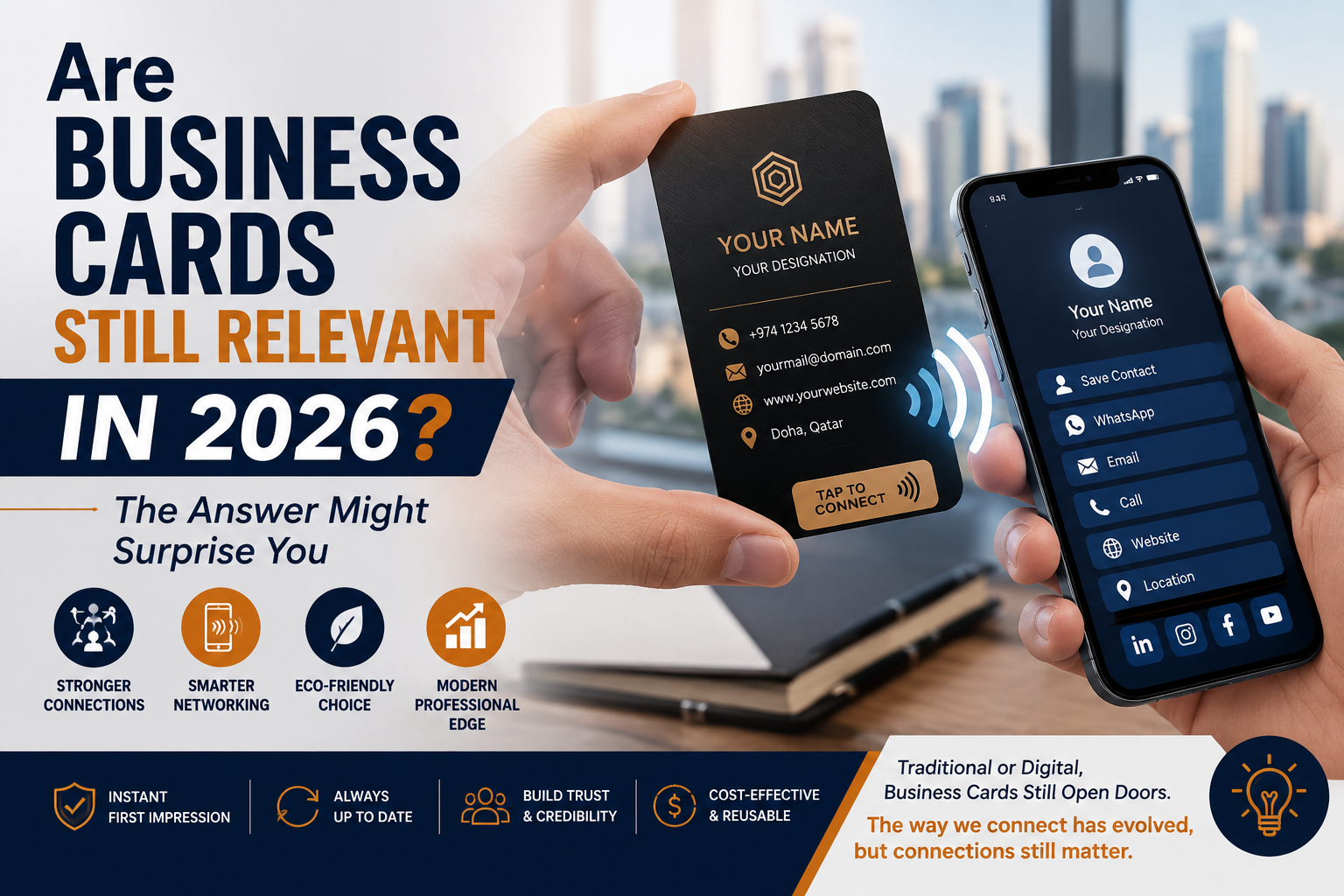
What has changed is that paper is no longer adequate for that function. The professional who pulls out an etap NFC business card — taps it to a client’s phone, watches their full digital profile open in two seconds, and sees the client immediately save their details — has achieved that function more completely than any paper card in history.
The business card hasn’t died. It has become smarter, faster, more useful, and more impressive. The professionals who understand this distinction are the ones making an outsized impression at every meeting.
Who Is Still Using Paper Cards — and Why It’s Costing Them
Paper cards persist most strongly in industries with longer adoption cycles: legal, traditional finance, some government sectors, and businesses run by professionals who learned networking in the pre-smartphone era.
In Qatar’s context, paper cards are still common at:
- Traditional trade and construction sector meetings
- Some government and semi-government business contexts
- Networking events hosted by older professional associations
- Businesses that haven’t yet experienced the friction their paper cards create
In every one of these contexts, the professionals using etap NFC cards are standing out. Not because of gimmickry — because the card creates a genuinely better experience for the recipient, and the recipient notices.
The cost of staying with paper is not just the printing expense. It’s the contacts that don’t follow up because the data entry friction was too high. It’s the outdated information that creates confusion when someone tries to reach you six months later. It’s the missed impression at a meeting where the other party tapped their card to your phone, and you handed them a piece of card stock in return.
The etap Answer: NFC Cards That Solve Every Paper Problem
etap’s NFC business cards are the direct solution to every failure mode of paper identified above. Here’s how each problem maps to a specific etap capability:
Paper goes out of date → etap profiles update in real time. Change your phone, title, website, or any link in your digital profile. Every card you’ve ever handed out now shows the correct information. No reprinting. No outdated contacts.
Paper requires manual entry → etap contacts are saved in one tap. The recipient taps your card to their phone. Their browser opens to your profile. They tap “Save Contact.” Done. The manual entry step is eliminated.
Paper carries only the basics → etap profiles carry everything. Your etap digital profile includes every contact channel, every social platform, your website, your portfolio, your booking page, your Google reviews, your WhatsApp — all accessible from a single tap. The complete professional introduction, not a truncated one.
Paper has no feedback loop → Etap provides tap analytics. See when your card was tapped, how many times, and which links received clicks. For the first time, your networking activity generates data you can act on.
Paper can’t be updated → etap profiles can. Always current, always correct, always reflecting where you are right now — not where you were when you last ordered cards.
The Two Questions to Ask Yourself
Before deciding whether to continue with paper cards, answer these honestly:
Question 1: Of the paper cards you handed out in the last 12 months, what percentage resulted in a meaningful connection?
If you don’t know — and most professionals don’t, because paper provides no data — that’s part of the problem. The 88% discard rate suggests the answer is lower than you hope.
Question 2: When someone hands you their paper card, what do you actually do with it?
Be honest. Does it go in your wallet and make it into your contacts? Or does it go in your jacket pocket, migrate to a desk, and eventually disappear?
If your answer to question two reflects the norm rather than the exception, your contacts are having the same experience with your cards.
Business Cards in Qatar: The Moment We’re In
Qatar’s professional environment in 2026 is at an interesting inflection point. The country’s rapid development — new corporate campuses, luxury hotels, expanding financial and technology sectors, a growing ecosystem of entrepreneurs and SMEs — means that networking is happening at scale, with high stakes, across a professional community that is both internationally sophisticated and growing fast.
In this environment, the professionals who have adopted NFC digital cards are visibly ahead of the ones who haven’t. Not by much at every individual meeting — but the compounding effect of better first impressions, higher contact retention, complete digital profiles, and the conversational moment that an Etap metal or PVC card creates is measurable over months and years.
The shift from paper to NFC in Qatar is following the same trajectory as smartphone adoption, contactless payment adoption, and every other technology shift in the country: accelerating adoption among forward-thinking professionals, followed by rapid mainstream uptake as the advantages become undeniable.
The question for any professional reading this is simply: which side of that adoption curve do you want to be on?
Which etap Card Is Right for You?
PVC NFC Business Card — QAR 150. Full-colour custom design. Credit card sized. NFC chip + QR code. Custom digital profile. The professional baseline — modern, functional, brand-correct. Right for: team members, sales professionals, any professional who values design freedom and cost efficiency.
Metal NFC Business Card — QAR 200. Available in gold, silver, black, white, and rose gold. Laser-engraved. 25–35 grams. NFC chip + QR code. The card people keep. Right for: executives, senior consultants, business owners in premium sectors, anyone whose first impression needs to communicate investment and quality.
Both cards link to a live digital profile, editable at any time, at no additional cost. Both work with any NFC-enabled smartphone — no app required on the recipient’s side.
Frequently Asked Questions
Are business cards still relevant in 2026?
Yes — more relevant than ever, but in digital form. The need to exchange professional contact information at the moment of introduction has not diminished. What has changed is that paper is no longer adequate for that function. NFC digital business cards solve every limitation of paper while creating a better experience for both parties.
Do people in Qatar still use paper business cards?
Yes, particularly in traditional industries and older professional networks. However, NFC card adoption is accelerating across Qatar’s corporate, hospitality, healthcare, and entrepreneurial sectors. Professionals using NFC cards at networking events are consistently standing out from those using paper.
What percentage of paper business cards get thrown away?
88% within one week of being received. This is the most cited statistic in the digital business card industry and reflects a consistent finding across multiple research surveys.
Will an NFC card work with my client’s phone?
Yes. NFC is built into every iPhone from the iPhone 7 onwards (iOS 13+ for automatic tag reading) and all modern Android devices. No app download is needed. The recipient simply taps your card and their browser opens to your profile.
Can I update my etap NFC card after ordering?
The digital profile (what the card links to) is fully editable at any time at no cost. Change your phone number, job title, social links, website, or any other information — every card you’ve handed out immediately reflects the update. The physical card never needs replacing.
How does an NFC card compare to just sharing a contact via phone?
Sharing via phone requires both people to actively participate in the exchange — opening apps, finding contacts, confirming transfer. An NFC card is a one-sided action: you hold out the card, the recipient taps their phone to it, and their browser opens to your full profile instantly. No action required from them until they decide to save your details. It is faster, more impressive, and more reliable.
Conclusion
Business cards are not dead. The ritual of introducing yourself to a new professional contact with a physical card — the handoff, the glance, the pocket — remains a genuine human moment that digital tools haven’t replaced.
What has changed is that the card doing the work of that introduction needs to be better than a piece of paper. It needs to save to contacts without friction. It needs to carry your complete professional presence. It needs to stay accurate as your career evolves. It needs to give you some signal that the connection you made was real.
Paper cannot do any of these things. An etap NFC business card does all of them — from the first tap to the last update, years later, when you’ve changed roles or launched a new venture and your card already reflects it.
The shift is happening. Qatar’s most forward-thinking professionals have already made it. The only question is when you will.
Order your Etap NFC business card today.
📱 WhatsApp: +974 55769142 📧 [email protected] 📍 Al Naif Souq, Ain Khaled, Doha, Qatar 🌐 etap.qa
Custom-designed. NFC-enabled. Produced in Doha. Ready to make every first impression count.