Introduction
You use RFID cards every day — you might not know it yet.
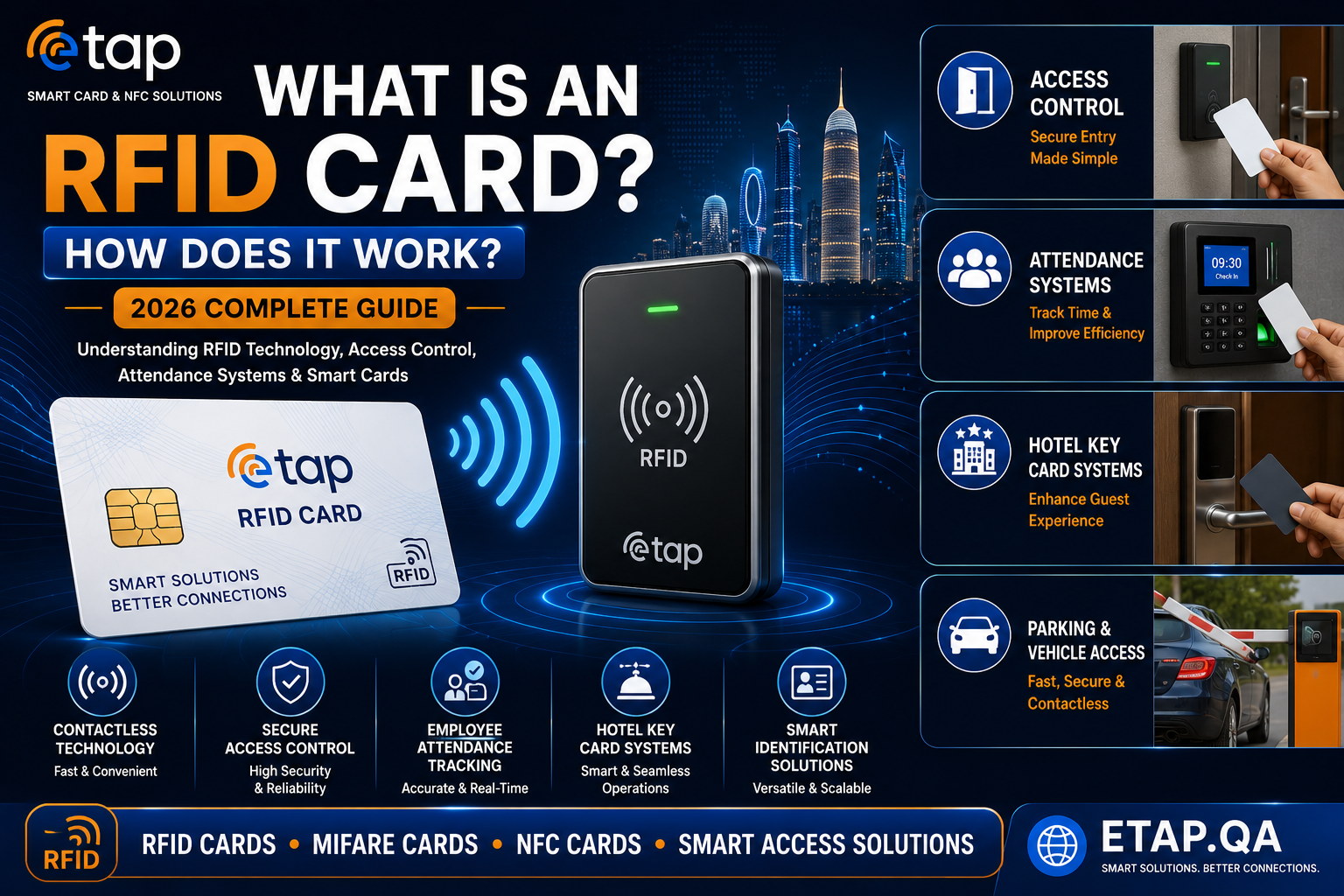
The card that opens your office door. The fob that raises the car park barrier. The transit card you tap at the metro station. The hotel key card lets you into your room. The access badge that logs your attendance. All of these are RFID cards. And in Qatar, where smart building technology, gated communities, modern offices, and EV infrastructure are expanding rapidly, RFID cards are more relevant than ever.
This guide covers everything: what an RFID card is, how the technology works in practice, the different types available, how they’re used across industries in Qatar, and how etap helps businesses design and deploy RFID card solutions that meet their specific needs. There’s also a dedicated section on RFID cards for EV charging — one of the fastest-growing applications in Qatar right now.
What Exactly Is an RFID Card?
An RFID card is a physical card — typically credit card-sized — that contains a small embedded microchip and an antenna. Together, these two components allow the card to communicate wirelessly with an RFID reader using radio waves, without any physical contact and without a battery.
RFID stands for Radio Frequency Identification. The “identification” part is the keyword: the primary job of an RFID card is to identify itself to a system. When you hold your access card near a reader on a door, the reader sends out a radio signal, the card’s antenna picks up that signal and uses it as power, and the chip broadcasts back a unique identifier. The system checks that identifier against its database and — if you’re authorized — unlocks the door.
The entire exchange happens in milliseconds. From the user’s perspective, it’s instant.
RFID cards look identical to standard bank cards or ID cards from the outside. The chip and antenna are laminated invisibly inside the card body. They require no charging, no pairing, and no maintenance. Properly made, an RFID card lasts five to ten years of daily use.
How Do RFID Cards Work?
The process behind every RFID card interaction follows the same four steps, regardless of the application:
Step 1: The reader emits a radio frequency field. When an RFID reader is powered on, it continuously broadcasts a low-power radio signal at a specific frequency — most commonly 125 kHz (Low Frequency) or 13.56 MHz (High Frequency). This field extends a few centimeters to a few meters around the reader, depending on the system design.
Step 2: The card enters the field. When you bring your RFID card within range of the reader, the card’s internal antenna picks up the radio energy from the reader’s field.
Step 3: The chip is powered and responds. The energy captured by the antenna is enough to briefly power the microchip — no battery required for passive RFID cards. The chip reads its stored data (typically a unique ID number) and transmits it back to the reader via the antenna.
Step 4: The reader processes the response. The reader receives the card’s ID, passes it to the connected system (an access control panel, a time-attendance database, a payment terminal, an EV charging station), and the system takes the appropriate action — unlocking a door, logging attendance, initiating a charge session.
This entire sequence typically completes in under 100 milliseconds. It’s why RFID feels instant — because it effectively is.
Active vs Passive RFID Cards
Passive RFID cards — the most common type — have no internal power source. They are powered entirely by the reader’s electromagnetic field during the moment of reading. They are thin, inexpensive, long-lasting, and ideal for access control, transit, attendance, and payment applications.
Active RFID cards — less common and more expensive — contain their own battery, which allows them to broadcast a signal continuously over much longer ranges (up to 100 meters). These are used in specialized tracking applications: vehicle tracking, asset location in large warehouses, and personnel tracking on large construction or industrial sites.
For the vast majority of business applications in Qatar — building access, attendance tracking, EV charging, canteen payments, visitor management — passive RFID cards are the right choice.
How Many Types of RFID Cards Are There?
RFID cards are categorized primarily by the frequency at which they operate. Each frequency range has distinct characteristics that determine the right application.
Low Frequency (LF) RFID Cards — 125 kHz
The original RFID standard for access control. LF RFID cards (also called EM4100 or HID Prox cards) are widely used in older building access systems, vehicle immobilizers, and some industrial environments.
Characteristics:
- Read range: up to 10 cm
- Data transfer speed: slow
- Strong performance near water and metal
- Limited data storage capacity
- Less secure than modern alternatives (no encryption on most LF cards)
Common uses in Qatar: Legacy office access control systems, older hotel key systems, some industrial gate controls.
etap note: LF RFID cards are still in active use but are being phased out in modern installations in favor of HF RFID (MIFARE) due to security limitations. etap supplies LF cards for compatibility with existing systems and advises on upgrade paths.
High Frequency (HF) RFID Cards — 13.56 MHz
The current standard for smart card applications. HF RFID cards include the MIFARE family (by NXP Semiconductors), which is the most widely deployed contactless card technology in the world. Transit systems, modern access control, payment cards, and NFC-enabled cards all operate at 13.56 MHz.
Characteristics:
- Read range: up to 10 cm (access control) to ~1 meter (industrial readers with larger antennas)
- Fast data transfer
- Supports encryption and mutual authentication (much more secure than LF)
- Large data storage capacity
- NFC-compatible (smartphones can read HF RFID cards that follow NFC standards)
Common MIFARE variants:
- MIFARE Classic — the original, widely used but with known security vulnerabilities; still used in lower-security applications
- MIFARE DESFire — advanced encryption, used in high-security access control and transit systems
- MIFARE Ultralight — low-cost, limited capacity, used for event tickets and single-use passes
- NTAG series — NFC-standard tags, used in smart marketing, NFC business cards, and consumer applications
Common uses in Qatar: Modern office and residential building access, metro and transit cards, hotel key cards, corporate attendance systems, visitor management, EV charging stations, and eTap NFC business cards.
Ultra-High Frequency (UHF) RFID Cards — 860–960 MHz
UHF RFID enables much longer read ranges and faster throughput than LF or HF. UHF cards and tags can be read from 1 to 12 meters, depending on antenna design, and multiple cards can be read simultaneously.
Characteristics:
- Read range: 1 to 12+ meters
- Very fast data transfer; bulk reading of multiple tags simultaneously
- Performance affected by water and metal (requires careful antenna design near these materials)
- Used with handheld or fixed readers, not typically with standard door-mounted readers
Common uses in Qatar: Vehicle identification at car park barriers and gated communities (windshield tags), retail inventory management, warehouse and logistics tracking, construction site equipment tracking, airport baggage handling, supply chain management.
etap note: etap supplies UHF RFID cards and windshield tags for vehicle access control — a growing requirement in Qatar’s gated residential developments, corporate campuses, and logistics facilities.
Comparison Table: RFID Card Types
| Feature | LF (125 kHz) | HF (13.56 MHz) | UHF (860–960 MHz) |
|---|---|---|---|
| Read range | Up to 10 cm | Up to 10 cm–1 m | 1–12+ meters |
| Speed | Slow | Medium–Fast | Very fast |
| Security | Low | High (DESFire) | Medium–High |
| NFC compatible | No | Yes (NTAG/MIFARE) | No |
| Simultaneous reads | No | Limited | Yes |
| Best for | Legacy access control | Modern access, payments, NFC | Vehicle access, inventory, logistics |
| Typical card cost | Very low | Low–Medium | Medium |
RFID Cards Across Industries in Qatar
Office and Corporate Access Control
The most common RFID card application in Qatar. HF RFID (MIFARE) cards grant employees access to buildings, floors, server rooms, and secure areas. The same card can link to an attendance management system, tracking clock-in and clock-out automatically. etap supplies branded, custom-printed RFID access cards that carry both the company’s visual identity and the functional RFID credential.
Residential and Gated Communities
Qatar’s high-end residential developments — from The Pearl to Lusail — use RFID for resident access. HF RFID cards for pedestrian gates and elevators; UHF windshield tags for vehicle entry. etap supplies both, including branded cards for property management companies and HOAs.
Hotels and Hospitality
Hotel room key cards in Qatar are almost universally HF RFID (MIFARE). The same card technology also enables cashless payments in hotel canteens, access to gym and pool facilities, and staff attendance tracking. Katara Hospitality properties and other major Qatar hospitality operators use RFID infrastructure throughout their operations.
Healthcare
Hospitals and clinics use RFID cards for staff access control, drug cabinet security, patient wristband tracking, and asset management. RFID ensures that only authorized personnel access sensitive areas — a requirement under healthcare compliance standards in Qatar.
Education
Universities and schools across Qatar use RFID student ID cards that double as access credentials, library cards, and cashless payment cards for campus facilities. A single card handles multiple functions across the campus ecosystem.
Logistics and Warehousing
Qatar’s logistics sector — serving Hamad Port and the wider Gulf supply chain — uses UHF RFID for pallet tracking, inventory management, and container identification. UHF’s long range and bulk-reading capability make it the only practical choice at the scale these operations require.
How to Get an RFID Card for EV Charging: The Ultimate Guide
Electric vehicle adoption in Qatar is accelerating. With the government’s push toward sustainable transport and a growing network of EV charging stations across Doha, Al Wakrah, Lusail, and beyond, RFID cards for EV charging are an increasingly relevant topic for both individuals and fleet operators.
Why EV Charging Stations Use RFID
Most public and semi-public EV charging stations in Qatar use RFID authentication to:
- Identify the user before a charging session begins
- Link the session to an account for billing, reporting, or access control
- Prevent unauthorized use of charging points in gated or corporate locations
- Enable fleet management — tracking which vehicle charged, for how long, and at what cost
When you tap your RFID card at a charging station, the station reads your card’s unique ID, verifies it against the network’s database, and authorizes your charging session. At the end, the session data is logged to your account automatically.
Types of RFID Used in EV Charging
Most EV charging networks in Qatar and globally use HF RFID at 13.56 MHz, typically MIFARE Classic or DESFire. This is the same frequency used for access control cards, transit cards, and NFC — which is why some EV charging networks also support tap-to-charge via smartphone (using the phone’s NFC in card emulation mode).
How to Get an RFID Card for EV Charging in Qatar
Option 1: Through your EV charging network provider Most public charging networks in Qatar issue RFID cards to registered users. Sign up for an account with your preferred network, complete the registration, and request a card. The card is linked to your account and billing method.
Option 2: Corporate or fleet RFID cards If your business operates an EV fleet or installs private charging points at your premises, you’ll need RFID cards programmed to your charging management system. etap works with businesses across Qatar to supply, program, and print custom-branded RFID cards for private EV charging infrastructure — including gated compounds, corporate car parks, and hotel charging bays.
Option 3: RFID-enabled access cards with EV charging functionality Some smart building operators in Qatar are integrating EV charging access into their existing RFID access card systems — so a single card handles building access, attendance, and EV charging authorization. etap can help design and supply multi-application RFID cards that carry multiple credentials on a single card body.
What to Look for in an EV Charging RFID Card
- Compatibility: Confirm the card frequency (13.56 MHz for most modern networks) matches your charging station’s reader
- Durability: EV charging environments involve weather exposure, heat, and physical handling — specify a card rated for outdoor use
- Security: For fleet or corporate deployments, choose DESFire encryption over MIFARE Classic
- Branding: etap can print your company logo and name on any RFID card — useful for fleet cards that need to be clearly identified by vehicle or driver
RFID Card FAQs
What is an RFID card used for?
RFID cards are used for building access control, attendance tracking, hotel room keys, transit passes, cashless payments, vehicle gate access, EV charging authorization, visitor management, and more. In Qatar, they are used across corporate, residential, hospitality, healthcare, and logistics environments.
Can RFID cards be copied or cloned?
LF RFID cards (125 kHz, EM4100) can be cloned with widely available hardware — a significant security risk in older access control systems. Modern HF RFID cards using MIFARE DESFire encryption are highly resistant to cloning due to mutual authentication protocols. If your system uses older LF cards, upgrading to HF DESFire is strongly recommended. etap advises on security upgrades as part of our RFID solutions service.
Do RFID cards expire?
The physical card and chip do not expire — a well-made RFID card can last a decade or more. The card’s access credentials can be deactivated or expire in software (on the access control system) regardless of the physical card’s condition. This means you can issue a card and revoke access without retrieving the physical card.
Can an RFID card be blocked by a wallet or case?
Standard RFID cards are not easily blocked by proximity to other cards, wallets, or cases in normal circumstances. However, metallic surfaces directly against the card can reduce read range. RFID-blocking wallets, which contain a Faraday cage layer, will prevent the card from being read while inside — useful for preventing unauthorized reads of contactless payment cards when not in use.
How many credentials can one RFID card hold?
HF RFID cards (MIFARE DESFire in particular) support multiple applications on a single card — so one card can hold an access credential, an attendance credential, a canteen payment application, and an EV charging credential simultaneously. This is called a multi-application card and is the direction modern smart card deployments are taking.
What’s the difference between an RFID card and an NFC card?
NFC is a specific type of HF RFID operating at 13.56 MHz with a standardized protocol stack that makes it compatible with smartphones. All NFC cards are RFID cards, but not all RFID cards are NFC. Standard access control MIFARE Classic cards are HF RFID, but are not NFC-standard. etap NFC business cards are both HF RFID and NFC — readable by both dedicated readers and any NFC-enabled smartphone.
Can I use my phone instead of an RFID card?
For NFC-standard HF RFID systems, yes — modern smartphones can emulate an RFID credential using NFC Card Emulation Mode. Many modern access control and EV charging systems support mobile credentials alongside physical cards. However, this requires the system to support mobile credential enrollment, which not all legacy systems do. For reliable, universal access, a physical RFID card remains the most dependable credential.
How do I order RFID cards for my business in Qatar? C
Contact etap via WhatsApp (+974 55769142) with your requirements: the type of system you’re running (or planning to deploy), the number of cards needed, and any branding requirements. etap supplies, programs, and prints RFID cards for businesses across Qatar, including access control cards, attendance cards, visitor passes, and custom fleet or EV charging cards.
Conclusion
RFID cards are the quiet backbone of Qatar’s smart building infrastructure, corporate access systems, hospitality operations, and increasingly, its EV charging network. They work because the technology is proven, reliable, and invisible — you tap, and it works.
Understanding which type of RFID card your application requires — LF, HF, or UHF — and what security level is appropriate is the foundation of any successful RFID deployment. That’s where etap’s experience matters: we don’t just supply cards, we help businesses design the right system from the start.
Whether you need a single custom access card, a branded batch for your team, a multi-application smart card that consolidates three systems into one, or RFID cards programmed for your EV charging infrastructure — etap handles the full process in Doha, from specification to programming to delivery.
Get in touch today.
📱 WhatsApp: +974 55769142 📧 [email protected] 📍 Al Naif Souq, Ain Khaled, Doha, Qatar 🌐 etap.qa