Introduction
Something is changing in how Qatar’s businesses handle identity, access, networking, and customer engagement — and it’s happening at the card level.
Walk into any modern office tower in West Bay, a five-star hotel in Lusail, a private hospital in Al Waab, or a gated residential development on The Pearl, and you’ll find the same shift: paper cards, physical keys, and manual sign-in sheets have been replaced by smart cards that tap, transmit, and track in milliseconds. RFID and NFC technology — once the domain of large enterprises with large budgets — is now accessible to businesses of every size across Qatar, from a single-location café launching a loyalty program to a logistics company tracking thousands of assets across Hamad Port.
The demand for premium smart card solutions in Qatar is accelerating for three converging reasons. First, Qatar’s rapid infrastructure development — new corporate campuses, residential communities, hotels, and healthcare facilities — all require access control and identification systems from day one. Second, the country’s high smartphone penetration rate makes NFC’s consumer-facing applications (digital business cards, review cards, tap-to-pay) immediately viable. Third, businesses across every sector are recognising that the card a customer, employee, or client holds is a brand touchpoint — and that a premium card makes a premium impression.
This guide covers everything a business in Qatar needs to know about RFID and NFC cards: what the technology is, what the benefits are, which card types suit which applications, and how etap designs, programs, and produces the full range from our Doha workshop.
What Are RFID & NFC Cards?
Understanding RFID Technology
RFID stands for Radio Frequency Identification. It is a wireless technology that uses radio waves to transfer data between a tag (embedded in a card, label, or fob) and a reader device. The tag contains a microchip that stores a unique identifier and an antenna that receives power from the reader’s electromagnetic field — meaning most RFID cards require no battery.
When an RFID card enters the field of a compatible reader, the chip powers up, transmits its stored data, and the reader passes that information to a connected system — which then takes action: unlocking a door, logging an attendance record, authorizing a vehicle entry, or initiating a payment.
RFID has been in commercial deployment since the 1980s and is one of the most battle-tested wireless technologies in existence. It operates across three primary frequency ranges, each suited to different applications:
Low Frequency (LF) — 125 kHz: Short read range (up to 10 cm), resistant to interference from water and metal. Used in legacy access control systems, animal microchips, and vehicle immobilizers. Older hotel key fob systems typically use LF RFID.
High Frequency (HF) — 13.56 MHz: Read range up to 1 meter, high data transfer speed, supports encryption. The standard for modern smart cards including MIFARE, contactless payment cards, transit cards, and NFC. This is the frequency used by etap’s full NFC and MIFARE card range.
Ultra-High Frequency (UHF) — 860–960 MHz: Long read range (1–12+ meters), can read multiple tags simultaneously. Used in warehouse inventory management, supply chain tracking, vehicle identification at barriers, and retail inventory systems.
Understanding NFC Technology
NFC stands for Near Field Communication. It is a specific subset of HF RFID that operates at 13.56 MHz, with a deliberately restricted read range of approximately 4 centimeters — the distance of a deliberate tap or touch.
NFC was developed and standardized in the early 2000s specifically for consumer-device integration. The result: virtually every modern smartphone — every iPhone since the iPhone 7, every flagship and mid-range Android device — has an NFC chip built in. This is what makes NFC uniquely powerful for business applications: the reader is already in your customer’s, client’s, or employee’s pocket.
NFC operates in three modes:
Reader/Writer Mode: A smartphone reads or writes to a passive NFC tag. This is the mode used when a client taps your etap NFC business card and your digital profile opens on their phone.
Card Emulation Mode: The smartphone mimics a contactless smart card. This is how Apple Pay, Google Pay, and contactless bank card transactions work.
Peer-to-Peer Mode: Two NFC devices exchange data directly. Used for device pairing and file transfer between smartphones.
Key Differences Between RFID and NFC
| Feature | RFID | NFC |
|---|---|---|
| Frequency | LF (125 kHz), HF (13.56 MHz), UHF (860–960 MHz) | HF only (13.56 MHz) |
| Read range | Up to 12+ meters (UHF) | Up to ~4 cm |
| Communication | Primarily one-way | Two-way capable |
| Smartphone compatible | No (requires dedicated reader) | Yes — built into all modern phones |
| Best for | Infrastructure, logistics, access at scale | Consumer interactions, payments, digital cards |
| All NFC is RFID? | N/A | Yes — NFC is a subset of HF RFID |
The simplest way to understand the relationship: all NFC is RFID, but not all RFID is NFC. They are not competing technologies — they are complementary tools, each the right choice for different use cases within the same smart card ecosystem.
Benefits of RFID & NFC Cards
Enhanced Security
RFID and NFC cards offer fundamentally stronger security than paper credentials, physical keys, or manual sign-in systems. Modern HF RFID cards using MIFARE DESFire encryption employ mutual authentication protocols and AES-128 or AES-256 encryption — cryptographic standards that make cloning or interception effectively impossible under normal conditions.
Practical security benefits include: the ability to deactivate a lost or stolen card remotely without recovering the physical card; audit trails showing exactly when and where each card was used; access levels that restrict individual cards to specific doors, floors, or time windows; and immediate revocation when an employee leaves.
For businesses in Qatar operating in sectors with compliance requirements — healthcare, finance, government, hospitality — RFID access card systems provide a documented, auditable security layer that manual systems cannot replicate.
Contactless Convenience
The defining user experience of RFID and NFC is the tap: one motion, under a second, no physical contact required. For high-traffic access points — office building lobbies, hotel room corridors, gym turnstiles, hospital department doors — the efficiency difference between a tap-to-enter system and a manual key or PIN system compounds significantly over a working day.
For customer-facing NFC applications, the convenience is equally compelling. A customer tapping an etap NFC review card or digital business card completes the interaction in two seconds — no searching, no typing, no friction.
Faster Access and Identification
A well-configured RFID access system processes a card read in under 100 milliseconds. Multiply that across dozens of employees passing through an access point at shift change, or guests checking in at a hotel during peak hours, and the time saving is substantial. For logistics and warehouse environments using UHF RFID, entire pallets of tagged inventory can be scanned simultaneously as they pass a fixed reader — manual barcode scanning of the same items might take hours.
Durable and Reusable
RFID and NFC cards have no moving parts, no battery (for passive cards), and no components that wear through repeated use in the way that magnetic stripes do. An Etap MIFARE card or NFC business card is rated for tens of thousands of read cycles and a physical lifespan measured in years rather than months. This durability translates directly into lower replacement costs and less waste compared to paper credentials or magnetic stripe cards that degrade with use.
Professional Branding
Every card an employee carries, or a customer receives, is a brand touchpoint. A custom-printed RFID access card with your company logo, brand colors, and employee photo communicates that your organization operates to a consistent, professional standard. An etap metal NFC business card in gold or black tells the recipient, before they’ve read a word on the card, that the person handing it to them operates at a premium level.
etap handles design as part of every card production process — your brand identity is applied correctly and consistently across every card in your order, whether it’s 10 executive metal NFC cards or 500 employee ID cards for a corporate campus.
Cost-Effective Solution
The upfront cost of premium RFID and NFC cards is offset by multiple long-term savings: fewer replacements due to durability, elimination of paper credential printing and reprinting, reduced administrative time managing manual access systems, and — for NFC business cards — the complete elimination of recurring paper card print runs. A QAR 150–200 NFC business card that lasts five years and never goes out of date costs significantly less over its lifespan than the annual paper card budget for the same professional.
Types of Premium Cards Offered by etap
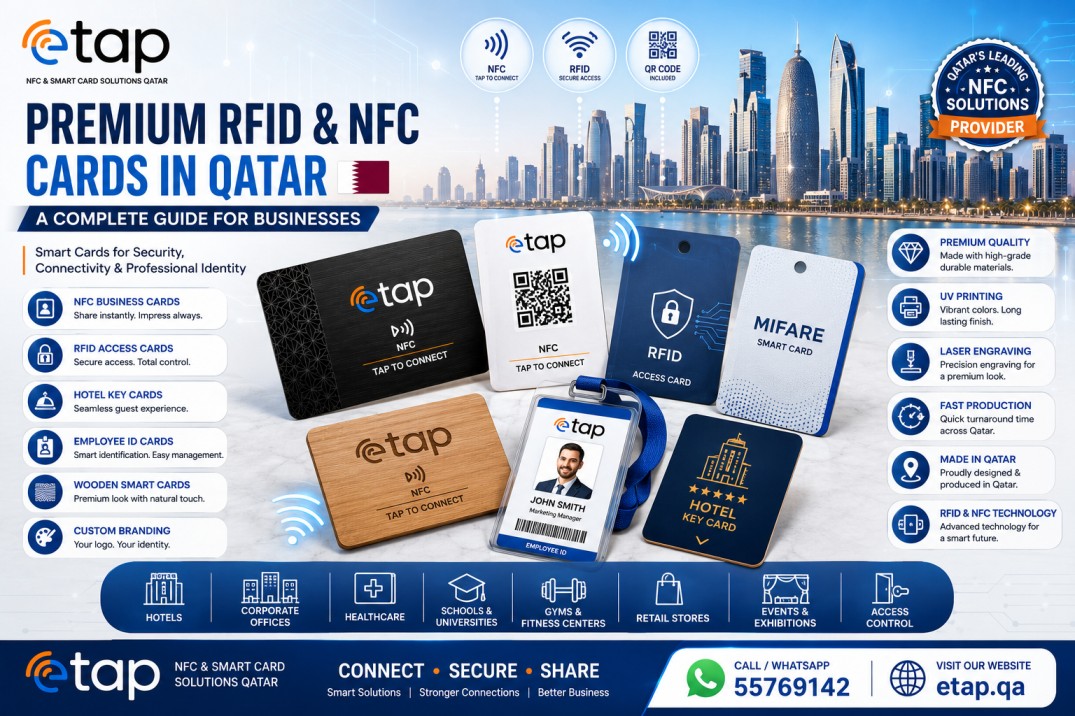
NFC Digital Business Cards
etap’s flagship product. A credit-card-sized card embedded with an NFC chip and linked to a fully custom digital profile. One tap on the card opens the profile on any smartphone — sharing contact details, social links, website, portfolio, booking page, or any URL the cardholder chooses. The profile updates in real time without replacing the card. Available in PVC (QAR 150) and metal (QAR 200).
RFID Access Cards
HF RFID (MIFARE) or LF RFID access cards programmed to work with door access control systems, time-attendance readers, and building management infrastructure. Custom printed with company branding. Available in standard PVC card format, proximity card format, and clamshell fob format. etap supplies access cards compatible with all major access control systems deployed across Qatar.
MIFARE Smart Cards
MIFARE is the world’s most widely deployed smart card technology, developed by NXP Semiconductors and operating at 13.56 MHz. etap supplies the full MIFARE range:
MIFARE Classic — The established standard for lower-security access and transit applications. Large installed base across Qatar’s commercial buildings.
MIFARE DESFire EV2/EV3 — Advanced encryption (AES-128/256), multi-application capability, high-security access control. The correct choice for new installations requiring serious security. Supports multiple credentials on a single card — access control, attendance, canteen payment, and more.
MIFARE Ultralight — Low-cost, limited-capacity cards for event passes, single-use credentials, and short-term visitor access.
Hotel Key Cards
Qatar’s hospitality sector runs on MIFARE HF RFID hotel key cards. etap supplies custom-designed, branded hotel key cards for properties across Doha — printed with the hotel’s visual identity, programmed to work with the property’s lock system, and produced to the quality standard that five-star hospitality demands. Also available with NFC functionality for properties that want guests to tap their key card for additional services — menu access, spa booking, review links.
Employee ID Cards
A combined identity and access credential — the standard for corporate campuses, hospitals, universities, and government facilities across Qatar. etap produces employee ID cards with full-color photo printing, UV lamination, barcode or QR code on the reverse, RFID or NFC chip embedding, and optional magnetic stripe. Holographic overlaminates and security features are available for high-security environments.
Wooden NFC Cards
One of etap’s most distinctive premium products. Wooden NFC business cards are crafted from sustainably sourced wood — typically bamboo, cherry, or maple — with laser-engraved branding and an embedded NFC chip. The result is a card that is simultaneously premium, eco-conscious, and unforgettable. No two wooden cards have the same grain pattern, making each one genuinely unique. Ideal for sustainability-focused brands, natural wellness businesses, architects, designers, and any professional whose brand identity aligns with natural materials.
Metal NFC Business Cards
etap’s most premium NFC card offering. Available in five metal finishes — gold, silver, black, white, and rose gold — with laser engraving or UV printing and an embedded NFC chip. Weight: 25–35 grams. Read range: any NFC smartphone at tap distance. Lifespan: effectively unlimited under normal daily use. Priced at QAR 200. The card most likely to start a conversation, earn a desk placement, and remain in the recipient’s possession indefinitely.
Google Review NFC Cards
A purpose-built NFC card that opens your Google review page the moment a customer taps it with their smartphone. No app, no searching, no typing. Also available as an acrylic counter stand for permanent placement at reception desks, restaurant tables, salon checkout counters, and clinic waiting areas. NFC + QR code on every card for maximum compatibility. Starting from QAR 50.
Industries That Use RFID & NFC Cards
Hotels & Hospitality
Qatar’s hospitality sector — from international five-star brands to boutique properties — is one of the most intensive users of smart card technology in the country. MIFARE HF RFID hotel key cards control room access, floor lifts, gym and pool entry, and minibar locking. NFC-enabled key cards allow guests to tap for digital menus, review links, and service requests. Staff ID cards with RFID credentials manage back-of-house access. Google Review NFC stands at checkout to capture guest feedback at the highest satisfaction moment.
Corporate Offices
Modern office buildings across West Bay, Lusail, and the new Qatar Financial Centre developments use RFID access card systems as standard infrastructure. Employee MIFARE DESFire cards control access at lobby turnstiles, floor readers, server room doors, and car park barriers. The same card integrates with time-attendance systems for payroll accuracy. Visitor management systems issue temporary MIFARE Ultralight passes for day visitors. Executive teams use etap NFC metal business cards for client and partner introductions.
Schools & Universities
Qatar Foundation campuses, international schools, and private universities use student and staff ID cards that combine photo ID, library card, canteen payment, and campus access in a single MIFARE multi-application card. Attendance tracking via RFID readers at classroom or campus entry points generates automated attendance data without manual roll calls. Visitor passes manage non-student access to secure areas.
Hospitals & Clinics
Healthcare facilities in Qatar operate some of the most rigorous access control environments in the country. MIFARE DESFire cards with high-security encryption control access to ICUs, pharmacy stores, operating theaters, and data server rooms — ensuring only authorized personnel can enter sensitive clinical areas. Employee ID cards carry staff credentials, department access levels, and photo ID in a single durable card. Patient wristbands with RFID tags enable bedside identification. etap’s custom hospital ID cards are produced to the durability standards that healthcare environments demand.
Gyms & Fitness Centers
Qatar’s growing fitness sector — from boutique studios in The Pearl to large gym chains across Doha — uses RFID membership cards for entry turnstile control, class check-in, locker assignment, and food/beverage purchases within the facility. RFID membership cards eliminate the need for staff to manually verify membership at entry, reduce queue times during peak hours, and generate usage data that helps facility managers understand peak times and popular services.
Retail Stores
Retail applications for RFID in Qatar span from UHF inventory management in large format retail (real-time stock counts without manual scanning) to NFC customer-facing applications (loyalty cards, Google review cards at checkout, NFC product authentication tags on luxury goods). etap supplies retail clients with custom PVC loyalty cards, NFC review stands for checkout areas, and branded promotional NFC cards for campaigns.
Warehouses
Qatar’s logistics and warehousing sector — centered around Hamad Port, the industrial areas of Mesaieed and Doha South, and the numerous free zone facilities — uses UHF RFID as the backbone of inventory management. UHF RFID tags on pallets, containers, and individual items can be read simultaneously from up to 12 meters by fixed portal readers, enabling real-time inventory tracking without manual scanning. Staff access cards with RFID credentials control entry to secure warehouse zones.
Residential Communities
Qatar’s premium residential developments — gated compounds, high-rise towers, and master-planned communities — use RFID infrastructure for resident access at pedestrian gates, vehicle entry barriers, elevator floors, amenity areas (gym, pool, cinema room), and visitor management systems. Residents receive MIFARE access cards and UHF windshield tags for their vehicles. etap supplies residential management companies with branded access cards for all resident tiers.
Events & Exhibitions
Qatar hosts major international exhibitions, conferences, and events throughout the year — at DECC, the Qatar National Convention Centre, and purpose-built venues in Lusail and Hamad International Airport. RFID wristbands and cards for event access control, cashless payment, and session attendance tracking are standard at large events. Single-use MIFARE Ultralight cards serve as entry tickets with embedded access credentials. NFC-enabled exhibitor cards allow exhibitors to share their digital profiles with visitors via tap during the event.
Customization Options
etap offers a comprehensive range of customization options across its entire card range. Every card produced at our Doha workshop reflects the client’s brand identity — not a generic template.
Company Logo Printing
Your company logo is applied to every card in your order with precise color matching and correct proportions. etap’s design team adapts logos for card-scale production — ensuring fine details, gradients, and color values reproduce correctly at the constraints of the card format.
UV Printing
Full-color UV printing directly onto the card surface produces vivid, precise color reproduction with excellent durability. UV inks cure instantly under ultraviolet light, creating a scratch-resistant finish that maintains its appearance through years of daily handling. Available in gloss or matte finish on PVC cards.
Laser Engraving
Used primarily on metal and wooden NFC cards. Laser engraving creates a permanent, tactile marking in the card material — text and logos are etched into the surface rather than printed on top of it. The result is precise, premium, and impossible to replicate with printing alone. Running a finger across laser-engraved text on a metal card is a sensory experience that defines the premium card category.
QR Codes
QR codes are printed on card reverses to provide a smartphone-scannable version of the same link carried by the NFC chip. This ensures that every card works for every customer, regardless of whether they prefer NFC tap or QR scan. etap prints QR codes at the correct size and contrast to ensure reliable scanning in all lighting conditions.
Barcodes
Linear barcodes (Code 128, Code 39, EAN-13, and other formats) are printed on employee ID cards, library cards, membership cards, and any application where a barcode reader is part of the existing system infrastructure. etap prints variable data barcodes — each card in a batch can carry a unique, sequential barcode number.
Employee Photos
Full-color photo printing on employee ID cards and access cards. etap accepts photo files supplied by the client and prints them at the correct resolution and color balance for card-scale reproduction. Holographic overlay laminates can be applied over photo areas for additional security.
Variable Serial Numbers
Each card in a batch can carry a unique printed serial number, membership number, or employee ID — either visible on the card face or encoded in a barcode/QR code. Variable data printing is managed digitally, allowing batches of hundreds of individually numbered cards to be produced in a single production run.
Custom Shapes and Finishes
Beyond standard credit card dimensions, etap produces cards in custom shapes — for brands whose identity calls for a distinctive format. Finish options include gloss lamination, matte lamination, spot UV coating (gloss finish applied selectively over a matte base), soft-touch coating (a velvety tactile surface), and for metal cards: brushed, mirror-polished, and matte metal finishes.
Why Wooden & Metal NFC Cards Are Becoming Popular
Premium Appearance
In a market flooded with standard PVC cards, a wooden or metal card is immediately distinctive. The material communicates something before the card is even read — that the person presenting it has invested in how they are perceived. Qatar’s professional culture, where personal presentation and the quality of business materials are taken seriously, is a natural fit for premium card materials.
Luxury Branding
For businesses operating in luxury segments — premium real estate, private banking, five-star hospitality, luxury retail, wealth management — the standard of every physical touchpoint is part of the brand experience. A gold metal NFC business card handed to a high-net-worth client, or a wooden NFC card offered by an eco-luxury wellness brand, extends the brand experience beyond the meeting and into the client’s daily life for as long as they carry the card.
Eco-Friendly Options
Wooden NFC cards, produced from sustainably sourced bamboo or FSC-certified hardwood, offer a genuinely eco-conscious alternative to PVC without sacrificing premium feel. For businesses with sustainability commitments, ESG reporting requirements, or brand identities built around environmental responsibility, a wooden NFC card is the correct product choice — it communicates values as well as contact details.
Metal cards also carry a sustainability argument: one card lasting five to seven years replaces multiple paper and PVC card print runs, reducing cumulative material waste significantly.
Long-Lasting Durability
Both wooden and metal NFC cards outlast standard PVC cards by a significant margin under real-world daily use. Metal cards are effectively indestructible under normal pocket-and-wallet carry. Wooden cards, sealed with a protective finish, resist warping and moisture at levels comparable to PVC. The NFC chip embedded in both is rated for 100,000+ read cycles — far beyond any reasonable daily use scenario. The result is a card that remains presentable and functional for the full period between rebrand or role changes.
RFID vs NFC: Which Card Is Right for Your Business?
Feature Comparison
| Feature | RFID (UHF/LF) | NFC (HF 13.56 MHz) |
|---|---|---|
| Read range | Up to 12+ meters (UHF) / 10 cm (LF) | Up to ~4 cm |
| Simultaneous reads | Yes (UHF) | No |
| Smartphone compatible | No | Yes |
| Security level | Medium (LF) / High (HF DESFire) | High |
| Best material for | PVC, clamshell fob | PVC, metal, wood |
| Suitable for consumer use | No | Yes |
| Infrastructure required | Dedicated readers | Smartphone (built-in) |
| Cost per card | Low–Medium | Low–High (by material) |
Best Use Cases for Each Technology
Choose RFID when: Your application requires long read range, simultaneous bulk reading, or integration with dedicated infrastructure that doesn’t involve consumer smartphones. Warehouse inventory tracking, vehicle identification at barriers, supply chain management, and large-scale asset tracking all require UHF RFID. Legacy LF RFID (125 kHz) is appropriate when compatibility with existing older systems is needed.
Choose NFC when: Your application involves consumer-facing interactions, smartphone compatibility, or premium physical formats like metal and wooden business cards. Digital business cards, Google review cards, loyalty cards, hotel key NFC features, contactless payments, and any application where the recipient’s own smartphone is the reader are all NFC territory.
Choose HF RFID (MIFARE) when: Your application is access control, attendance, or smart building infrastructure. MIFARE operates at 13.56 MHz — the same frequency as NFC — but uses different protocol stacks optimized for security and multi-application smart card use. MIFARE DESFire is the correct choice for new access control installations requiring strong encryption and multi-credential capability.
Use both when: Many businesses in Qatar benefit from a combined approach: HF RFID (MIFARE) cards for employee access control and attendance, plus NFC business cards for executive networking, plus NFC Google review cards for customer-facing locations. etap works with clients to design the full card ecosystem, ensuring every credential type is correctly specified and consistently branded.
Why Choose etap Qatar?
Premium-Quality Materials
etap sources card materials to the same specification used by international card manufacturers — PVC to ISO/IEC 7810 ID-1 standard, MIFARE chips from NXP Semiconductors, NFC NTAG213/216 chips for consumer NFC applications, and metal and wood substrates selected for consistency and durability. There are no shortcuts in our material supply chain because our clients’ cards reflect their brands.
Fast Production
All etap cards are designed, printed, and programmed at our Al Naif Souq, Ain Khaled workshop in Doha. No international shipping, no customs delays, no quality uncertainty. From design approval to finished cards, etap delivers some of the fastest production turnaround times available for premium custom cards in Qatar.
Fully Customized Designs
etap does not produce generic template cards with a logo dropped in. Every card starts with your brand — your logo, your colors, your layout, your content — and our design team builds from there. The result is a card that looks like it was made for your business specifically, because it was. Design is included in every order.
RFID & NFC Expertise
etap’s team understands RFID and NFC at a technical level — frequency selection, chip specification, encoding formats, protocol compatibility, and system integration. This means we don’t just sell cards; we advise on the correct card type for your system, ensure encoding compatibility with your existing infrastructure, and troubleshoot any integration issues. If you’re building a new system, we help you specify it correctly from the start.
Local Support Across Qatar
etap is based in Doha and serves clients across Qatar — from The Pearl and Lusail in the north to Mesaieed and Al Wakrah in the south. We’re reachable via WhatsApp for fast consultation, and available in person at our workshop for clients who want to see material samples and discuss requirements face to face. Our support doesn’t end at card delivery — we’re available for reprogramming, reordering, and system integration queries ongoing.
Reliable Delivery
Every card order is quality-checked before leaving our workshop. NFC and RFID cards are tested for chip read performance. Printed cards are checked for color accuracy and laminate adhesion. We communicate realistic timelines and meet them — because our clients’ card programs depend on it.
Frequently Asked Questions
What is the difference between RFID and NFC cards?
RFID is a broad family of wireless identification technologies spanning multiple frequency ranges. NFC is a specific subset of HF RFID (13.56 MHz) standardized for consumer device compatibility. All NFC cards are RFID cards, but not all RFID cards are NFC. The key practical difference: NFC cards work with any modern smartphone without additional hardware; standard RFID cards require a dedicated reader. For a full technical breakdown, see etap’s dedicated NFC vs RFID guide on this site.
Can RFID and NFC cards be customized?
Yes — completely. etap produces fully custom RFID and NFC cards with your logo, brand colors, employee photos, serial numbers, barcodes, QR codes, and any design element your application requires. Available in PVC, metal, and wood, in standard or custom shapes, with gloss, matte, spot UV, and soft-touch finishes. Design is included in every order.
Are NFC business cards compatible with iPhones and Android phones?
Yes. NFC is built into every iPhone from iPhone 7 onwards (iOS 14 and later), and into all modern Android devices from Samsung, Huawei, OnePlus, Google, and others. No app is required on the recipient’s phone — they tap your card, and it opens directly in their browser. In Qatar, where both iPhone and Android are widely used across all demographics, NFC card compatibility is effectively universal.
How secure are RFID access cards?
Security depends on the card type. LF RFID cards (125 kHz, EM4100 format) offer minimal security and can be cloned with widely available hardware — not recommended for new installations. HF RFID cards using MIFARE Classic offer moderate security; known vulnerabilities exist but require specific equipment to exploit. MIFARE DESFire EV2/EV3 cards with AES-128/256 encryption provide enterprise-grade security — mutual authentication, encrypted data transmission, and clone resistance that meets financial and government-grade security standards. etap strongly recommends MIFARE DESFire for any new access control installation.
Can I order cards with my company logo?
Yes — every etap card order includes custom design with your company logo applied correctly to the card format. Share your logo file (vector preferred: .ai, .eps, or high-resolution .png) and brand colors, and etap’s design team handles the rest, producing a proof for your approval before any cards go to production.
Which industries benefit the most from smart cards?
Every industry with physical access points, employee identification requirements, or customer touchpoints benefits from smart cards. In Qatar, the highest adoption is currently in hospitality (hotel key cards, guest NFC features), corporate offices (access control, employee ID), healthcare (staff access, department security), education (student ID, campus access, canteen payment), retail (loyalty cards, NFC review cards), and logistics (UHF RFID inventory and asset tracking). etap serves all of these sectors and more from our Doha workshop.
How long does production take for a custom card order?
Production time depends on card type, quantity, and customization complexity. Contact etap via WhatsApp (+974 55769142) with your requirements, and we’ll provide a specific timeline. For urgent orders, expedited production is available — discuss your deadline at the point of enquiry.
Can one card carry multiple functions?
Yes. MIFARE DESFire multi-application cards can carry multiple credentials simultaneously — for example: building access, floor access, canteen payment, and attendance tracking on a single card. etap programs multi-application cards for corporate and hospitality clients where card consolidation reduces the number of cards each employee needs to carry.
Conclusion
The shift from paper credentials and physical keys to premium RFID and NFC smart cards is not a future trend in Qatar — it is the present reality across the country’s most modern offices, hotels, hospitals, schools, and residential developments. The businesses and professionals that have made this shift are operating more securely, more efficiently, and with stronger brand impressions than those still relying on outdated systems.
RFID technology provides the secure, scalable infrastructure for access control, attendance, inventory management, and asset tracking. NFC technology provides the consumer-facing, smartphone-compatible layer for digital business cards, Google review tools, loyalty programs, and smart marketing. Together, they form a complete smart card ecosystem that addresses every physical credential and customer touchpoint a business in Qatar needs to manage.
etap delivers both — with premium materials, full custom design, professional chip programming, and fast local production from our Doha workshop. Whether you need a single gold metal NFC business card for a managing director, 200 custom employee ID cards for a new corporate campus, or a complete RFID access control card program for a residential development, the process is the same: contact us, get a design proof, approve it, and receive cards that reflect the standard your business deserves.
Smart cards are not an upgrade — they are the baseline for businesses that take security, efficiency, and brand presentation seriously in 2026. etap is Qatar’s partner for getting there.
Order your premium RFID or NFC cards today.
📱 WhatsApp: +974 55769142
📧 [email protected]
📍 Al Naif Souq, Ain Khaled, Doha, Qatar 🌐 etap.qa
Custom-designed. Programmed in Doha. Delivered across Qatar.