Introduction
Qatar’s business environment is undergoing a quiet but significant transformation. Across corporate offices in West Bay, hotels in Lusail, restaurants in The Pearl, and retail outlets throughout Doha, a single category of technology is replacing decades-old tools: contactless cards.
Paper business cards, traditional metal keys, magnetic stripe access cards, and printed loyalty cards are being systematically replaced by smart contactless alternatives — NFC business cards, RFID access cards, Mifare security cards, and Google Review NFC stands. The shift is driven by a simple reality: contactless technology does everything the old tools did, and a great deal more, at a comparable or lower long-term cost.
The demand for smart business solutions in Qatar has grown rapidly as the country’s economy diversifies and digitises. Qatar’s National Vision 2030 and the broader push toward digital transformation across both public and private sectors have created fertile ground for contactless technology adoption — and Qatar’s businesses, increasingly competing on customer experience and operational efficiency, are responding accordingly.
This guide is the complete buyer’s resource for any Qatar business evaluating contactless card solutions in 2026. By the end, you will understand exactly what contactless cards are, the different technologies and types available, which industries benefit most, how to choose the right solution for your specific needs, and what to look for in a supplier — including why etap has become Qatar’s leading provider in this category.
What Are Contactless Cards?
Definition
A contactless card is any card-format product that uses wireless technology to transmit data to a reader or smartphone without requiring physical insertion, swiping, or contact. Instead, the card communicates through radio frequency signals when brought within a short distance — typically a few centimetres — of a compatible reading device.
Contactless cards have replaced magnetic stripe cards, embossed cards, and many printed paper products across banking, access control, professional networking, and customer engagement applications globally — and increasingly across Qatar.
How Contactless Cards Work
Every contactless card contains a small embedded chip and an antenna, sealed within the card body. The chip stores data — typically a unique identifier, a URL, or encrypted access credentials. The antenna allows the chip to communicate wirelessly with a compatible reader.
When the card is brought within range of a reader (or, for NFC cards, a smartphone), the reader’s radio field powers the chip wirelessly — no battery is required in the card. The chip transmits its stored data to the reader in a fraction of a second. The reader (or smartphone operating system) then acts on that data — granting access, opening a digital profile, recording attendance, or triggering any other programmed action.
NFC vs RFID Technology
Two underlying technologies power the contactless card category: NFC and RFID.
RFID (Radio Frequency Identification) is the broader technology category, encompassing low frequency (125 kHz), high frequency (13.56 MHz), and ultra-high frequency (860–960 MHz) variants. RFID is used extensively for access control, attendance systems, and large-scale asset and inventory tracking.
NFC (Near Field Communication) is a specific, smartphone-compatible implementation built on high-frequency RFID (13.56 MHz). NFC is the technology that allows any modern iPhone or Android smartphone to read a contactless card without any dedicated hardware — making it the technology of choice for consumer-facing applications like digital business cards and Google Review stands.
The relationship matters for buyers: a Mifare card (HF RFID) used for hotel door access can also be NFC-compatible, meaning the same physical card type underlies both your security system and your guest engagement tools.
QR Code Integration
Most premium contactless card products — including every card etap produces — also include a printed QR code alongside the NFC chip. This ensures universal compatibility: if a recipient’s phone does not support NFC tap (a small minority of older devices), they can simply scan the QR code instead and reach the same digital destination. This dual-technology approach means no customer, contact, or employee is ever excluded from interacting with your contactless card.
Types of Contactless Cards
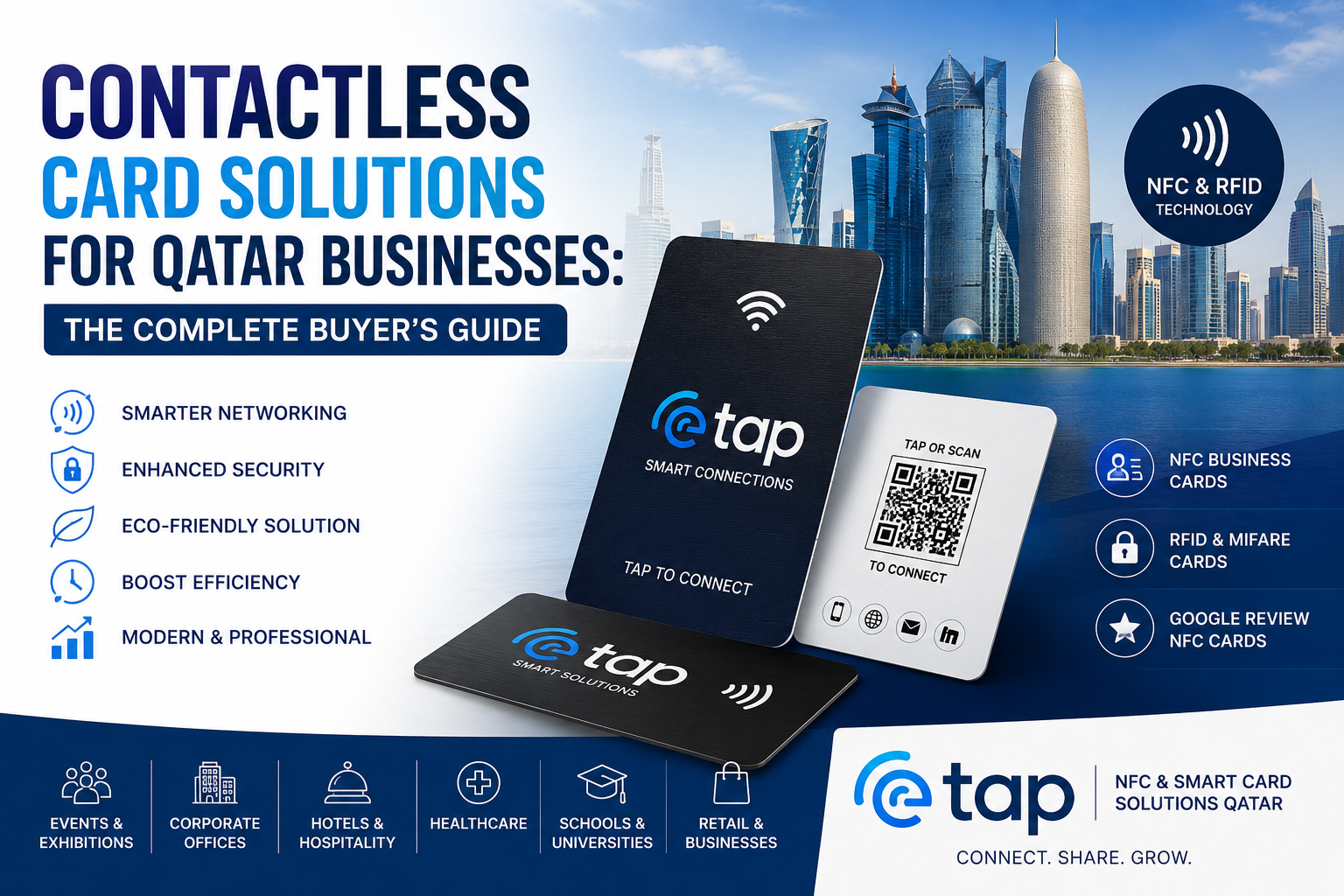
NFC Business Cards
NFC business cards are the most visible application of contactless technology for individual professionals. A tap on a smartphone opens a complete digital profile — replacing the paper business card entirely.
Professional networking — Share your complete contact information instantly at meetings, conferences, and networking events across Qatar, without the limitations of a printed card.
Digital profiles — Every NFC business card links to a BioLink digital profile containing your contact details, social media, website, portfolio, and more — fully editable at any time without reprinting.
Lead generation — For sales and business development professionals, NFC business cards capture every interaction with built-in analytics, showing exactly who engaged with your profile and when — turning every networking event into measurable activity.
RFID Cards
RFID cards form the backbone of physical security and operational systems across Qatar’s businesses and institutions.
Access control — RFID cards grant or restrict entry to buildings, floors, and rooms based on programmed permissions, with every access event logged centrally.
Attendance — RFID-based attendance systems automatically record employee check-in and check-out times, eliminating manual timesheets and improving payroll accuracy.
Parking systems — RFID cards and tags manage vehicle access to parking facilities, recording entry and exit automatically for billing and capacity management.
Employee identification — RFID cards combine visual staff identification (photo, name, department) with electronic access credentials in a single card.
Mifare Cards
Mifare is the dominant high-frequency RFID chip family used globally, offering the strongest combination of security and compatibility for sensitive applications.
High-security access — Mifare’s encryption capabilities (up to AES-128 on DESFire variants) make it the standard choice for facilities requiring robust protection against card cloning and tampering.
Hotels — Qatar’s hospitality sector relies extensively on Mifare cards for guest room key systems, with cards programmed per guest and automatically deactivated at checkout.
Universities — Education City institutions and universities across Qatar use Mifare cards for student and staff identification, campus access, library systems, and cafeteria payments.
Corporate offices — Qatar’s corporate sector uses Mifare cards for multi-level access control across office towers, with centrally managed permissions for every employee and contractor.
Google Review NFC Cards
A specialised application of NFC technology designed specifically for customer feedback collection.
Customer feedback — A single tap opens the business’s Google review page directly on the customer’s phone — removing every barrier between a satisfied customer and a five-star review.
Local SEO benefits — More reviews, collected consistently and recently, directly improve a business’s ranking in Google Maps and local search results — one of the most cost-effective marketing investments available to Qatar businesses.
Retail and hospitality — Restaurants, cafes, hotels, salons, and retail shops across Qatar use Google Review NFC cards and stands at checkout counters and tables to systematically grow their online reputation.
Social Media NFC Cards
Designed to convert physical customer interactions into digital following and engagement.
Influencers — Content creators and influencers in Qatar use NFC cards to direct new contacts instantly to their Instagram, TikTok, or YouTube profiles.
Personal branding — Professionals building a personal brand alongside their corporate role use NFC cards to direct contacts to curated personal content and social proof.
Marketing — Retail and hospitality businesses place NFC social media stands at point of sale to grow their follower base with every transaction.
Benefits of Contactless Cards for Businesses
Faster information sharing. A contactless card transmits complete information in under two seconds — compared to the multiple steps required to manually search for a business, type a URL, or transcribe contact details from a paper card.
Better customer experience. Removing friction from every customer interaction — leaving a review, viewing a menu, following on social media, accessing a digital profile — measurably improves customer satisfaction and engagement rates.
Eco-friendly alternative. A single contactless card replaces potentially thousands of printed paper cards, menus, or flyers over its operational lifetime — directly supporting Qatar businesses’ sustainability commitments.
Improved brand image. Premium contactless cards — particularly metal NFC cards and custom UV-printed acrylic stands — communicate a modern, professional, detail-oriented brand image at every customer touchpoint.
Editable digital profiles. Unlike printed materials, the content behind an NFC card can be updated at any time — new contact details, updated menus, refreshed promotions — without any reprinting cost or delay.
Increased productivity. Automated attendance tracking, instant access control, and frictionless customer data collection all reduce administrative burden and free up staff time for higher-value work.
Enhanced security. Encrypted RFID and Mifare cards provide significantly stronger protection against unauthorised access and card cloning than traditional keys, magnetic stripe cards, or PIN-based systems.
Industries Using Contactless Cards in Qatar
Corporate offices — Access control, employee ID, attendance tracking, and NFC business cards for client-facing staff across Doha’s financial, energy, and professional services sectors.
Hotels and hospitality — Mifare key cards for guest rooms, NFC cards for staff networking, and Google Review NFC stands for guest feedback across Qatar’s five-star hotel sector.
Restaurants and cafes — NFC food menu stands, Google Review cards, and social media NFC stands across Doha’s competitive food and beverage market.
Retail stores — Customer loyalty cards, social media engagement stands, and staff identification across Qatar’s mall and boutique retail sector.
Healthcare clinics — Secure Mifare access control for sensitive areas, staff identification, and patient management systems across Qatar’s private and public healthcare facilities.
Schools and universities — Student and staff ID cards, campus access control, library systems, and cafeteria payment integration across Qatar’s expanding education sector.
Gyms and fitness centres — Membership verification cards, access control to specific facility zones, and Google Review NFC stands across Qatar’s growing fitness and wellness sector.
Real estate agencies — NFC business cards for agents meeting high-value clients, and property marketing materials with embedded NFC links to virtual tours and listings.
Events and exhibitions — NFC-enabled attendee badges for lead capture, exhibitor business cards, and branded event signage across Qatar’s growing exhibition and conference sector.
NFC vs RFID: Which One Should You Choose?
| Feature | NFC | RFID |
|---|---|---|
| Reading Distance | Short (up to 4–5 cm) | Longer (cm to several metres depending on frequency) |
| Smartphone Compatible | ✔ Yes | ✖ No (requires dedicated reader) |
| Access Control | ✔ Yes | ✔ Yes |
| Business Networking | ✔ Yes | ✖ No |
| Attendance Systems | Limited | ✔ Yes |
| Security | High (with encrypted chips) | High (with HF/Mifare variants) |
The practical takeaway: if your application requires a customer, contact, or employee to interact using their personal smartphone, NFC is essential. If your application requires automated access control, attendance tracking, or asset management without smartphone involvement, RFID (particularly HF Mifare) is the appropriate technology. Many of etap’s products — Mifare access cards in particular — function as both simultaneously.
How to Choose the Right Contactless Card
Selecting the right contactless card solution for your Qatar business requires working through several practical considerations:
Business purpose. Are you solving an access control problem, a customer engagement problem, a networking problem, or an attendance tracking problem? Different purposes point to different card types — Mifare for security, NFC for engagement and networking.
Security requirements. For sensitive access control applications — hospitals, data centres, financial institutions — prioritise encrypted Mifare DESFire chips over basic NFC or unencrypted RFID. For consumer engagement, standard NFC chips (NTAG213/216) are entirely sufficient.
Card material. PVC offers an accessible, professional standard option. Metal offers a premium, memorable upgrade for senior professionals and client-facing roles. Wood offers a distinctive, eco-conscious alternative. Choose based on your professional context and brand positioning.
Custom branding. Ensure your chosen supplier offers full design customisation — your logo, brand colours, and messaging — rather than generic templated designs.
Compatibility. Confirm that any access control card is compatible with your existing reader infrastructure before ordering at scale. For consumer-facing NFC products, confirm dual NFC and QR code functionality for maximum compatibility.
Budget. Contactless card solutions span a wide price range — from QAR 10 basic RFID cards to QAR 200+ premium metal NFC business cards. Define your budget per use case rather than applying a single budget across very different applications.
Scalability. If you anticipate growing your card programme — more employees, more locations, more customer touchpoints — choose a supplier capable of consistent quality and fast turnaround at increasing volume.
Features to Look for in a Contactless Card Supplier
High-quality PVC and metal cards. Confirm the supplier offers genuine quality materials, not just basic printed plastic, particularly for premium business card applications.
UV printing. UV printing technology produces sharper, more durable, more vibrant results than standard digital printing — essential for any branded contactless card product.
QR code integration. Every NFC product should include a QR code backup to ensure universal compatibility regardless of the recipient’s device.
NFC encoding. Confirm the supplier properly programs every card with correct NDEF data before delivery — cards should work immediately out of the box.
RFID chip options. A capable supplier should offer multiple chip variants — basic NTAG for consumer applications, Mifare Classic for standard access control, and Mifare DESFire for high-security applications — and advise on the right choice for your use case.
Fast delivery. Confirm production and delivery timeframes before ordering, particularly for time-sensitive deployments like events or new office openings.
Custom branding. Full design customisation should be standard, with a proof and approval process before production begins.
Technical support. For access control and attendance applications in particular, ongoing technical support for system compatibility and troubleshooting is essential — not just a one-time product sale.
Why Businesses in Qatar Choose etap
etap is Qatar’s leading provider of contactless card solutions, based in Ain Khaled, Doha, and trusted by over 200 businesses and organisations across the country — including Qatar Airways, Katara Hospitality, Qatar Charity, Alfardan Corporation, and the University of Doha.
Premium NFC business cards — PVC from QAR 150, metal from QAR 200, available in white, black, gold, silver, and rose gold finishes, each with a free BioLink digital profile and real-time analytics.
RFID and Mifare cards — From QAR 10, fully customisable with company branding, employee photos, and access credentials, compatible with most access control systems used across Qatar.
Google Review NFC cards — From QAR 49, custom branded acrylic stands and cards that have helped Qatar restaurants and businesses dramatically increase their Google review volume and rating.
Corporate contactless solutions — Bulk ordering, volume pricing, and dedicated support for organisations deploying contactless cards across entire teams, departments, or properties.
Custom printing — Commercial-grade UV printing producing sharp, durable, vibrant results on every material etap works with — PVC, metal, acrylic, and wood.
Metal and PVC cards — The full range of materials to match any professional context, budget, and brand positioning.
Fast production — Quick turnaround from design approval to delivery, with free shipping to any address in Qatar.
Local support in Qatar — A real showroom in Ain Khaled, Doha, with direct WhatsApp support at +974 55769142 — not an overseas supplier with no local presence or accountability.
Frequently Asked Questions
What is the difference between NFC and RFID cards?
NFC is a specific, smartphone-compatible subset of high-frequency RFID. All NFC is RFID, but not all RFID is NFC. RFID covers a broader range of frequencies (low, high, and ultra-high) used for everything from access control to long-range logistics tracking. NFC specifically refers to the short-range, 13.56 MHz technology built into modern smartphones, used for consumer-facing applications like digital business cards and Google Review stands.
Can contactless cards work with iPhones?
Yes. NFC contactless cards work with all iPhones from iPhone 7 onwards (2016), using Apple’s background tag reading feature (iOS 13+) which automatically detects NFC tags without requiring any app to be open. RFID cards used for access control require a dedicated reader rather than a smartphone, regardless of phone brand.
Are NFC business cards reusable?
Yes, indefinitely. Unlike paper cards, an NFC business card never needs to be reprinted when your details change — you simply update your digital BioLink profile online, and the same physical card continues to work correctly for as long as the chip remains functional, typically many years.
Can I update my digital profile later?
Yes. Every etap NFC card links to an editable BioLink profile that you can update at any time — phone number, job title, social media links, website, or any other content — directly from your phone or computer, with no reprinting required.
Which businesses benefit most from contactless cards?
Any business with a customer or professional touchpoint benefits from contactless card technology. Restaurants and hotels benefit from Google Review and menu cards. Corporate offices benefit from access control and NFC business cards. Retail and fitness businesses benefit from social media and loyalty cards. The technology adapts to virtually any customer-facing or operational use case.
How secure are Mifare cards?
Mifare cards range from Mifare Classic (good security, suitable for most standard access control) to Mifare DESFire (bank-grade AES-128 encryption, suitable for high-security applications like hospitals, data centres, and government facilities). The right security tier depends on your specific risk profile and application — etap’s team can advise on the appropriate chip selection.
Can etap customise cards with my company logo?
Yes — full customisation is standard with every etap order, across every card type and material. etap’s design team produces a digital proof for your review and approval before any production begins, ensuring your branding, colours, and messaging are exactly as you want them.
Final Thoughts
Contactless technology is no longer an emerging trend in Qatar — it is the established standard for modern business networking, customer engagement, and access control. The businesses and professionals making the switch from paper cards, traditional keys, and printed materials are gaining measurable advantages: stronger first impressions, better customer engagement, more efficient operations, and meaningful cost savings over the long term.
Choosing the right contactless card solution depends on understanding your specific business goals — whether that is professional networking, customer review collection, secure access control, or operational efficiency — and matching that goal to the right technology, material, and security tier.
etap helps businesses across Qatar implement smart, reliable, and fully customisable contactless card solutions — from individual NFC business cards to enterprise-wide access control deployments. With local support, fast production, and a proven track record across 200+ Qatar businesses, etap is positioned to support your contactless technology needs at any scale.
Visit etap.qa to explore the complete range, or contact the team directly on WhatsApp at +974 55769142 for a free consultation on the right contactless card solution for your business.