
NFC technology has become part of everyday life. A simple tap can open a website, share contact information, display a digital menu, collect a Google review, connect someone to Wi-Fi, or provide product information.
But have you ever wondered what is actually inside an NFC tag?
Although an NFC sticker, card, or stand may look like a simple printed product, there are several components working together underneath the surface. Understanding these components can help businesses choose the right NFC tag for applications such as digital business cards, product information, customer engagement, asset identification, and contactless experiences.
In this guide, we’ll explain what is inside an NFC tag, how each component works, why the antenna matters, what NFC inlays are, and why some NFC tags are designed specifically for metal surfaces.
What Is an NFC Tag?
An NFC tag is a small electronic device that can communicate with an NFC-enabled smartphone or reader when brought within close proximity.
NFC stands for Near Field Communication and operates at 13.56 MHz. Most common NFC tags are passive, meaning they don’t require a battery.
Instead, the NFC-enabled smartphone or reader generates the electromagnetic field that provides the energy needed for the tag to communicate.
Depending on the application, an NFC tag can contain information such as:
- Website URLs
- Contact information
- Social media links
- Digital business card links
- Wi-Fi configuration information
- Product information
- Review links
- Digital menus
- Identification data
For many business applications, the NFC tag doesn’t need to store a large amount of information. It can simply store a URL that takes the user to online content.
What Is Inside an NFC Tag?
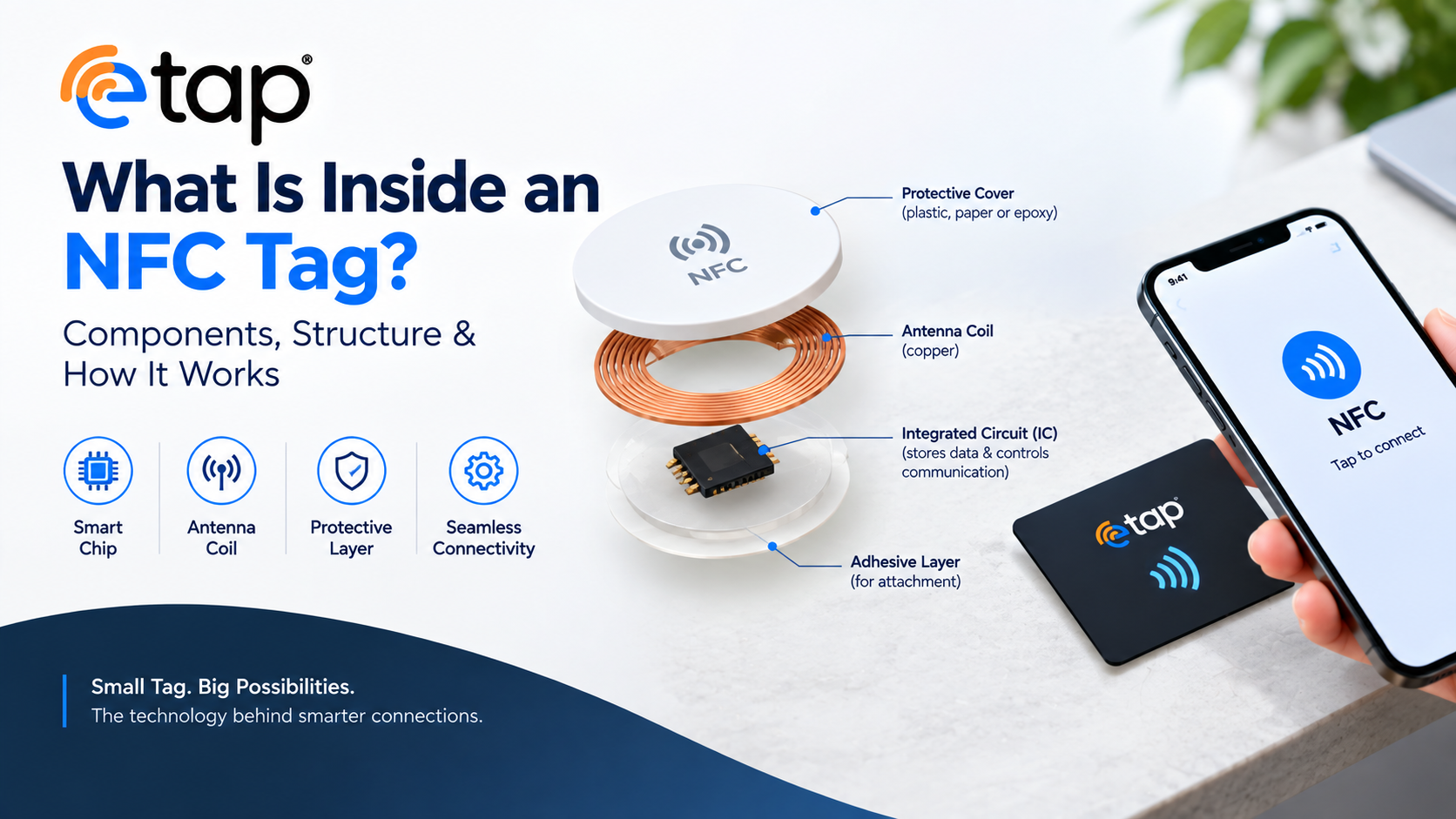
A typical NFC tag consists of several components.
The main components are:
- NFC chip
- Antenna
- Substrate or carrier material
- Protective layer or housing
- Adhesive layer, in the case of stickers and labels
The exact construction depends on whether the tag is a sticker, card, keychain, wristband, product label, metal-compatible tag or another form factor.
Let’s look at each component.
1. NFC Chip: The Brain of the Tag
The NFC chip, also called an integrated circuit (IC), is the electronic component that stores the tag’s information and manages communication.
It is extremely small compared with the overall size of the NFC tag.
The chip may contain:
- Memory
- A unique identifier
- Communication functions
- Data-locking features
- Password-protection features on supported chip types
Different NFC chips offer different amounts of memory and features.
Popular NFC chip families include products such as NTAG213, NTAG215, and NTAG216, although the appropriate chip depends on the application and required functionality.
Does a Bigger Chip Mean a Better NFC Tag?
Not necessarily.
For a basic business application where an NFC tag simply opens a short website URL, a large-memory chip may not provide any meaningful advantage.
In many real-world deployments, antenna design, tag construction, surface compatibility, and overall quality can be just as important—or more important—than memory capacity.
2. NFC Antenna: The Component That Makes Communication Possible
The antenna is one of the most important parts of an NFC tag.
It is usually a thin coil made from a conductive material such as copper or aluminium.
When you bring your smartphone close to an NFC tag, the phone generates an electromagnetic field.
The NFC tag’s antenna interacts with this field and harvests energy, allowing the passive chip to become active and communicate with the phone.
This means the antenna is responsible for much more than simply “sending a signal.”
Its design can influence:
- Read performance
- Operating distance
- Tag size
- Reliability
- Surface compatibility
- Performance near certain materials
This is why two NFC tags using the same chip can sometimes provide different user experiences.
Why Antenna Size Matters
A larger or appropriately designed antenna can provide different coupling characteristics compared with a very small antenna.
However, bigger isn’t automatically better.
The antenna needs to be correctly designed and tuned for the tag’s size, chip, and intended application.
3. Substrate: The Layer That Holds Everything Together
The antenna and chip need a material to support them.
This is commonly called the substrate or carrier layer.
Depending on the NFC product, it may be made from materials such as:
- PET
- Paper
- PVC
- Other suitable plastics or films
The substrate provides mechanical support and helps maintain the correct positioning of the antenna and chip.
For flexible NFC stickers, the substrate can be particularly important because the tag needs to remain functional while being handled or attached to a surface.
4. Protective Layer or Housing
The NFC chip and antenna are delicate components, so many NFC products include an additional protective layer.
The protection depends on the product design.
For example, an NFC tag may have:
- Laminated plastic
- PVC covering
- PET film
- Epoxy coating
- Rigid plastic housing
- Protective printing layer
The purpose is to protect the internal components from everyday wear and environmental exposure.
For a business card used indoors, a standard protective construction may be sufficient.
For an outdoor asset tag, equipment label, or industrial application, a more durable construction may be required.
5. Adhesive Layer in NFC Stickers
If you’re using an NFC sticker, there is another important component: adhesive.
The adhesive attaches the NFC tag to the intended surface.
This sounds simple, but adhesive selection can become important for long-term applications.
Factors can include:
- Surface material
- Indoor or outdoor use
- Temperature
- Moisture
- Surface texture
- Expected lifespan
- Permanent or temporary installation
An NFC tag may have excellent electronics, but if it doesn’t stay attached to the intended surface, it won’t provide a reliable long-term solution.
What Is an NFC Inlay?
You may also come across the term NFC inlay.
An NFC inlay is essentially the functional core of an NFC tag.
It generally contains the:
NFC chip + antenna + carrier/substrate
The inlay can then be incorporated into a finished product.
For example, the same basic NFC inlay concept can be integrated into:
- NFC cards
- NFC stickers
- NFC labels
- NFC keychains
- NFC wristbands
- Smart tags
- Product packaging
The finished product adds the appropriate outer material, printing, protection, and other features required for its intended use.
How Does an NFC Tag Work Without a Battery?
One of the most interesting things about NFC tags is that most of them don’t require a battery.
So how does the tag work?
When you bring an NFC-enabled smartphone close to the tag:
Smartphone NFC field → Tag antenna → Energy → NFC chip → Data exchange
The phone’s electromagnetic field provides energy to the passive tag.
The chip then communicates the stored information back to the smartphone.
This is why NFC is designed for very short-range communication.
You don’t normally need to physically connect your phone to the tag. Simply bringing the phone close enough allows the communication to take place.
What Information Can an NFC Tag Store?
This depends on the chip and application.
An NFC tag can store different types of information, including:
Website URL
One of the most common applications.
For example:
https://example.com
When someone taps the tag, the smartphone opens the associated webpage.
Digital Business Card
An NFC business card can direct users to a digital profile containing:
- Name
- Job title
- Phone number
- Website
- Social media
- Company information
Google Review Link
An NFC review card or stand can take customers directly to a business’s review page.
Digital Menu
Restaurants and cafés can use NFC stands to provide quick access to digital menus.
Social Media
An NFC card can direct customers to Instagram, Facebook, TikTok or another social platform.
The advantage of URL-based NFC applications is that the online destination can contain much more information than the small amount of memory available on the chip itself.
Why Do Some NFC Tags Not Work on Metal?
This is an important consideration when choosing NFC tags.
A standard NFC tag may perform poorly when placed directly on a metal surface.
Why?
NFC communication relies on electromagnetic coupling between the smartphone and tag antenna. A nearby conductive metal surface can interfere with the antenna’s electromagnetic behavior and affect its tuning.
The result can be:
- Reduced reading performance
- Unstable detection
- Very short read distance
- Failed communication
This is why on-metal NFC tags are specially designed for metal surfaces.
What Is an Anti-Metal NFC Tag?
An anti-metal or on-metal NFC tag is designed specifically to work when mounted on or near a metal surface.
One important difference is the inclusion of a ferrite or magnetic shielding layer between the antenna and the metal.
The shielding layer helps isolate the antenna from the conductive surface and allows the NFC tag to operate more reliably.
On-metal NFC tags can be useful for applications such as:
- Machinery identification
- Equipment tracking
- Metal containers
- Industrial assets
- Metal packaging
- Electrical equipment
- Product identification
If an NFC tag will be installed on metal, it is better to select a tag specifically designed for that application rather than simply placing a standard NFC sticker on the surface.
NFC Tag Materials: Why They Matter
The material used to construct an NFC tag isn’t only about appearance.
It can affect:
- Durability
- Flexibility
- Print quality
- Environmental resistance
- Surface compatibility
- Overall lifespan
For example, an NFC business card may prioritize premium appearance and print quality, while an industrial asset tag may prioritize durability and resistance to environmental conditions.
Therefore, the “best” NFC tag depends on where and how it will be used.
NFC Stickers vs NFC Cards
Both use the same fundamental NFC principle, but their physical design is different.
NFC Stickers
NFC stickers are useful when you want to attach NFC functionality to an existing object or surface.
Common applications include:
- Product labels
- Promotional materials
- Posters
- Tables
- Packaging
- Equipment
NFC Cards
NFC cards provide a more professional and durable form factor.
They can be used for:
- Digital business cards
- Employee identification
- Membership
- Access applications
- Networking
- Customer engagement
The internal NFC technology can be similar, but the surrounding construction is designed for a different purpose.
How Businesses Can Use NFC Tags
NFC technology is increasingly being used to connect physical products and spaces with digital experiences.
Some practical business applications include:
NFC Digital Business Cards
Professionals can share their contact details with a simple tap.
NFC Google Review Cards
Customers can be directed to a business’s review page without manually searching for it.
NFC Restaurant Menu Stands
Restaurants can provide contactless access to digital menus from a table.
NFC Social Media Cards
Customers can quickly access a business’s social profiles.
NFC Product Tags
Brands can connect physical products with digital information, instructions or online resources.
NFC Asset Identification
Businesses can use NFC tags to connect physical assets with digital records.
How to Choose the Right NFC Tag
Before purchasing NFC tags, consider these questions:
1. Where will the tag be used?
Indoor, outdoor, product packaging, cards, tables, or machinery all have different requirements.
2. What surface will it be attached to?
If the surface is metal, consider an anti-metal NFC tag.
3. What information needs to be stored?
For a simple URL, you may not need a high-memory chip.
4. Does the tag need protection?
Outdoor or industrial applications may require additional protection.
5. What size should the tag be?
The tag’s physical size can influence antenna design and user experience.
6. Does it need to be branded?
For customer-facing applications, consider custom printing, logos, colors, and QR-code integration.
NFC Tags and Smart Business Solutions in Qatar
For businesses in Qatar, NFC technology can be used to create practical contactless experiences across networking, hospitality, retail, marketing, and customer engagement.
ETAP provides NFC cards, NFC stands, smart-card products, and customized NFC solutions in Qatar for different business applications.
Whether you need an NFC digital business card, Google Review NFC stand, social media NFC card, or NFC food menu solution, the right product depends on your specific use case.
Explore ETAP’s NFC solutions:
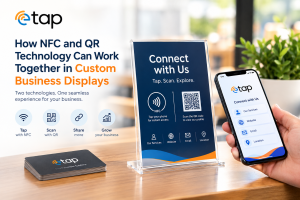
Businesses can also combine NFC and QR codes to provide customers with two convenient ways to access the same digital experience—tap for NFC-enabled smartphones or scan when using a camera.
Final Thoughts
An NFC tag may look like a simple sticker or card, but several components work together to make that small tap possible.
The chip stores information, the antenna enables wireless communication and energy harvesting, the substrate supports the components, and the outer layers provide protection and usability.
For specialized applications, additional construction—such as ferrite shielding for metal surfaces—may also be required.
When choosing an NFC tag, don’t look only at the chip name or memory capacity. Consider the antenna, surface, materials, environment, durability, size, and intended application.
The right NFC construction can make the difference between a tag that simply looks good and one that performs reliably in real-world business use.
Looking to use NFC technology for your business in Qatar? Explore ETAP’s NFC solutions and choose a format that fits your application.
Frequently Asked Questions
What is inside an NFC tag?
A typical NFC tag contains an NFC chip, antenna, and substrate. Finished products may also include protective layers, housing, and adhesive.
Does an NFC tag have a battery?
Most common NFC tags are passive and do not contain a battery. They receive energy from the electromagnetic field generated by an NFC-enabled phone or reader.
What does the NFC chip do?
The chip stores information and manages communication with an NFC-enabled device. It can also contain features such as a unique identifier and, depending on the chip, security or locking functions.
What is an NFC antenna?
The antenna is a conductive coil that interacts with the electromagnetic field generated by the smartphone or NFC reader. It helps power the passive tag and enables communication.
Can NFC tags work on metal?
Standard NFC tags can experience poor performance when placed directly on metal. For metal surfaces, specially designed anti-metal NFC tags with appropriate shielding are recommended.
Can an NFC tag store a website link?
Yes. Storing a URL is one of the most common NFC applications. When the tag is tapped with a compatible smartphone, the URL can open automatically.
What is an NFC inlay?
An NFC inlay is the functional core consisting primarily of the NFC chip and antenna mounted on a carrier material. It can be incorporated into cards, stickers, labels, and other finished products.