Introduction
You’ve decided to upgrade from paper business cards to NFC. Smart move. But now you’re facing a second decision that most people don’t think about until they’re staring at a product page: metal or PVC?
It’s not just an aesthetic preference. The material you choose affects how your card feels in someone’s hand, how it holds up over two years of daily use, what it says about your brand, and yes — how much you invest. Both metal and PVC NFC cards are professional upgrades over paper. But they serve slightly different purposes and send slightly different signals.
This guide walks you through everything: what each card is made of, how they perform, which type of professional or business they suit best, and the questions to ask yourself before you order. etap produces both — PVC and metal NFC cards — for professionals and businesses across Qatar, and we’ve helped enough clients make this decision to know exactly where each one wins.
Understanding NFC Cards: What They Are and How They Work
Before the metal vs PVC question, let’s make sure the foundation is solid.
An NFC business card is a physical card embedded with a small NFC (Near Field Communication) chip and antenna. When someone taps their smartphone against your card, the phone instantly reads the chip and opens whatever you’ve programmed — your digital profile, contact details, website, LinkedIn, portfolio, or any URL you choose.
No app required. No QR code to scan. No typing. Just tap.
The chip itself is the same regardless of material. What the material changes is:
- The feel and weight of the card in your hand and the recipient’s hand
- The print method and finish quality
- The durability and lifespan under daily use
- The brand impression it creates
That’s the whole comparison. Let’s go through each material properly.
What Are PVC NFC Cards?
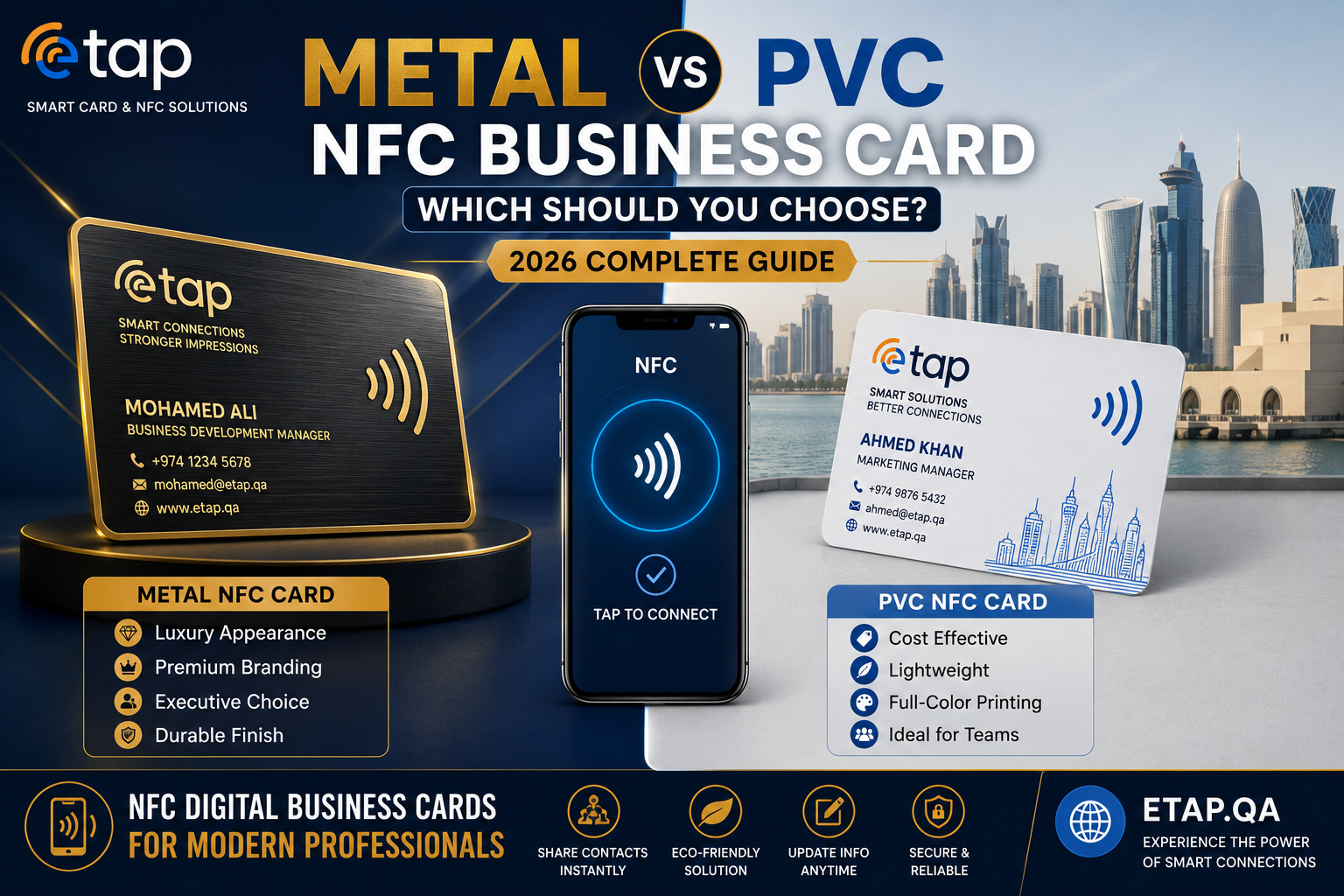
PVC stands for Polyvinyl Chloride — the same material used for standard credit cards, loyalty cards, and ID cards. It’s a rigid plastic with a smooth surface that accepts print extremely well.
etap’s PVC NFC cards are:
- Full-color UV printed — logos, photos, gradients, complex brand designs all reproduce cleanly and sharply
- Credit card sized — standard ISO/IEC 7810 ID-1 format (85.6 mm × 54 mm), fits every wallet and cardholder
- Lightweight — approximately 5–6 grams
- Available in white or black base, with custom design printed over the top
- Priced at QAR 150 — the most accessible entry point into NFC networking
PVC is the industry standard for smart cards globally. Your bank card, your Karwa transit card, your hotel key — all PVC. It’s a proven, reliable material that most people are already comfortable handling.
What Are Metal NFC Cards?
Metal NFC cards are made from stainless steel, aluminum alloy, or a hybrid metal-composite construction. They are heavier, more rigid, and finished with a premium surface treatment — brushed, matte, mirror-polished, or colored.
etap’s metal NFC cards are available in:
- Gold metal
- White metal
- Black metal
- Silver metal
- Rose gold metal
Each is priced at QAR 200 and built to a standard that reflects that investment. The laser engraving or UV printing on metal produces a sharp, tactile result that you simply cannot replicate on plastic.
Metal cards weigh roughly 25–35 grams — five to six times the weight of a PVC card. When you place one in someone’s hand, they notice the difference immediately. That’s not an accident. It’s the point.
Material Differences: Metal vs PVC
| Feature | PVC NFC Card | Metal NFC Card |
|---|---|---|
| Material | Rigid PVC plastic | Stainless steel / aluminum alloy |
| Weight | ~5–6 g | ~25–35 g |
| Thickness | ~0.76 mm (standard credit card) | ~0.8–1.0 mm |
| Print method | Full-color UV printing | Laser engraving + color printing |
| Color options | Unlimited (full-color design) | Preset finishes (gold, black, silver, white, rose gold) |
| Durability | High — resists bending, water-resistant | Very high — virtually indestructible under normal use |
| Feel | Familiar, smooth plastic | Heavy, cold, premium |
| First impression | Professional | Premium / luxury |
| Price (etap) | QAR 150 | QAR 200 |
| Best for | Teams, startups, frequent handouts, colorful brands | Senior executives, client-facing professionals, lasting impression |
Use Cases: When to Choose Metal vs PVC NFC Cards
Choose a PVC NFC Card When:
You want full creative control over your design. PVC accepts full-color UV printing with no constraints. If your brand has a specific color palette, a detailed logo, a gradient background, or a custom design that’s central to your identity, PVC gives your designer complete freedom. Metal finishes are beautiful, but they constrain your color options.
You’re equipping a team. If you need 10, 20, or 50 cards for your sales team, operations staff, or hospitality team, PVC is the practical choice. At QAR 150 per card, team-scale orders are far more manageable than metal. You still get the full NFC functionality — tap, share, connect — at a price that makes sense for volume.
You change roles or rebrand frequently. NFC cards are digitally editable (you can update what the tap links to at any time), but the physical card design is permanent. If your title, company, or brand identity is likely to change in the next year or two, PVC’s lower price makes re-ordering painless.
Your industry values approachability over prestige. In creative industries, tech startups, education, healthcare, and retail, a well-designed PVC NFC card hits exactly the right note — modern, professional, and brand-aligned without feeling ostentatious.
You want the most versatile finish. UV printing on PVC can produce a matte finish, a glossy finish, a spot UV effect, or even a soft-touch coating. The tactile options are wide.
Choose a Metal NFC Card When:
First impressions are your business. If you’re in real estate, private banking, wealth management, legal services, senior consulting, or luxury hospitality — the moment you hand someone your card is a moment of brand communication. A metal card communicates investment, permanence, and seriousness in a way that no paper or plastic card can match. People keep metal cards. They put them on desks. They show them to colleagues.
You represent a premium brand. etap’s corporate clients include organizations like Qatar Airways, Alfardan Corporation, Katara Hospitality, and The Chedi Hotel. At that level, the physical quality of every branded touchpoint matters. A metal NFC card isn’t just a networking tool — it’s a brand asset.
You carry a single card every day. If you’re a business owner, director, or senior executive who hands out cards regularly but not in volume, a metal card is built for that role. It survives years of daily pocket or wallet carry without scratching, warping, or looking tired.
You want the card to start a conversation. The most consistent feedback etap hears from metal card holders: the card itself becomes a talking point. The recipient holds it, turns it over, taps it — and asks “what is this?” You’ve just opened a conversation on your terms.
You value longevity over economy. A metal card at QAR 200 that lasts five years and creates a superior impression at every handout is excellent value. A PVC card replaced three times over the same period costs more and makes a softer impression each time.
Common Mistakes to Avoid When Choosing NFC Cards
Choosing material based on price alone. The QAR 50 difference between PVC and metal is not where the decision should live. Think about the impression value per handout. If you hand your card to ten potential clients a month, the cost difference is trivial compared to the difference in how those ten people perceive you.
Assuming metal cards always look better. A beautifully designed PVC card with strong brand identity and sharp UV printing looks more professional than a poorly conceived metal card. Design matters as much as material. etap handles both — our design team ensures every card, regardless of material, looks deliberate and brand-aligned.
Not thinking about your audience. Who are you handing this card to? A venture capitalist in West Bay and a supplier contact at an exhibition in DECC Qatar have different contexts. The best card is the one that feels right in the hands of the person receiving it.
Ordering without a digital profile set up. The NFC chip is only as useful as what it points to. Before your cards are printed, you should have your etap BioLink digital profile ready — your contact details, social links, website, and any portfolio or media you want to share. etap includes this setup with every card order.
Thinking NFC cards are a one-time decision. Your NFC card’s physical design is fixed, but what the tap links to is editable forever. Don’t stress about the destination URL changing — update your etap digital profile whenever your details change. The card never becomes outdated.
How to Make the Decision: Questions to Ask Yourself
Work through these before you order:
1. What is the primary context in which I hand out cards?
High-stakes client meetings → metal. Team members, exhibitions, general networking → PVC.
2. How important is full-color custom design to my brand identity?
Critical → PVC. I can work within a premium finish palette → metal.
3. Am I ordering for myself or for a team?
Solo professional → metal worth the investment. Team of 5+ → PVC for practicality.
4. What industry am I in?
Luxury, finance, real estate, hospitality, senior consulting → metal. Creative, tech, healthcare, education, retail → PVC.
5. How long do I expect to use this card before reordering?
2+ years, same role → metal’s durability makes sense. Likely to change soon → PVC is smarter.
6. What impression do I want to leave?
“This person is modern and professional” → both achieve this. “This person operates at a premium level” → metal does this clearly.
If you’re still unsure after these questions, contact etap on WhatsApp and describe your context. We’ll give you a straight recommendation.
NFC Cards in Qatar: A Growing Trend
Qatar’s professional and business culture has always placed a high value on personal presentation and brand signaling. The traditional exchange of business cards — the moment of introduction where you hand someone a physical piece of yourself — remains an important ritual across industries from finance and construction to hospitality and government.
NFC cards fit naturally into this culture. They don’t replace the ritual; they elevate it. Instead of handing someone a piece of paper that ends up in a pile of identical cards, you hand them a tap-enabled card that immediately connects them to everything you want them to see about you.
The growth of NFC card adoption in Qatar has been significant, and etap has been at the center of it. From individual professionals in Doha to enterprise rollouts for major corporations, the shift from paper to NFC is accelerating — and the professionals who make the switch early establish a clear competitive distinction.
Both PVC and metal NFC cards are available for immediate order and fast turnaround. Increasingly, etap sees a pattern among growing businesses: they start with PVC for their team and order metal cards for their senior leaders. That combination — team-wide NFC consistency plus executive-level premium impression — is the smart play for businesses that want both scale and prestige.
Conclusion: Which Should You Choose?
Here’s the honest summary:
Choose a PVC NFC card if you want full design freedom, are equipping a team, operate in a creative or tech-forward industry, or are making your first NFC card investment and want the most versatile option.
Choose a metal NFC card if you’re a senior professional, you work in an industry where premium presentation matters, you want a card that creates an immediate impression and lasts for years, or you want the card itself to be a conversation starter.
Both deliver the same NFC functionality. Both are custom-designed by etap to reflect your brand. Both connect your recipients instantly to your digital presence with a single tap. The difference is the material, the weight, the impression — and ultimately, what you want the person on the other side of the handshake to think about you.
etap designs, programs, and delivers both from our workshop in Doha. Same-day WhatsApp consultation. Fast turnaround. Every card production-approved by you before we print.
Ready to order your NFC business card in Qatar?
📱 WhatsApp: +974 55769142 📧 [email protected] 📍 Al Naif Souq, Ain Khaled, Doha, Qatar 🌐 etap.qa
Browse the full NFC card range — PVC and metal — at etap.qa