
Introduction
If you’ve ever tapped a card to enter a building, waved your phone at a payment terminal, or placed a tag near a reader to track inventory, you’ve used either NFC vs RFID technology. Most people use both without ever knowing the difference. Businesses in Qatar, on the other hand, need to know exactly which one to choose before investing in a system.
RFID and NFC are related technologies, but they are not the same. Choosing the wrong one for your use case can mean wasted investment, poor performance, or a system that simply doesn’t do what you need. This guide breaks everything down: what each technology is, how they differ, and which one is right for your business in 2026.
etap is Qatar’s leading provider of NFC cards, RFID cards, and smart contactless solutions for businesses and professionals. If you have questions after reading, we’re one WhatsApp message away.
What Is RFID?
RFID stands for Radio Frequency Identification. It is a technology that uses radio waves to transfer data wirelessly between a tag (which stores information) and a reader (which captures that information). The tag does not need a battery if it is a passive RFID tag — it draws power from the electromagnetic field generated by the reader.
RFID has been in commercial use since the 1980s and is one of the most widely deployed identification technologies in the world. You’ll find it in:
- Supply chain and logistics — tracking pallets, containers, and shipments across warehouses and ports
- Access control systems — building entry cards, car park barriers, gate systems
- Retail inventory management — stores that use RFID tags on individual products to monitor stock in real time
- Animal identification — livestock tracking and pet microchips
- Library systems — book tracking and self-checkout
- Key fobs and door access cards are used in hotels, offices, and residential buildings across Doha
The defining characteristic of RFID is that the reader doesn’t need to be close to the tag. Depending on the frequency and antenna configuration, RFID can read tags from centimeters to several meters away.
RFID Frequency Types
Not all RFID systems operate the same way. The frequency used determines the read range, data transfer speed, and ideal use case:
Low Frequency (LF) RFID — 125 kHz to 134 kHz Short read range (up to ~10 cm). Penetrates water and metal well. Commonly used in animal microchips, vehicle immobilizers, and some older access control systems. Slower data transfer.
High Frequency (HF) RFID — 13.56 MHz Read range up to ~1 meter. The standard for contactless smart cards, including transport cards, library systems, and payment cards. This is also the frequency used by NFC (more on that below).
Ultra-High Frequency (UHF) RFID — 860–960 MHz Read range from 1 meter up to 12+ meters. Much faster data transfer. Ideal for supply chain management, retail inventory, asset tracking, and logistics. Most modern warehouse and inventory systems use UHF RFID.
Microwave RFID — 2.45 GHz and 5.8 GHz. Very high speed, very long range in some configurations. Used in vehicle toll collection, real-time location systems, and specialized industrial applications.
Understanding which frequency your use case requires is the first step in choosing the right RFID solution — and it’s exactly where etap’s consulting services make a difference for businesses in Qatar.
What Is NFC?
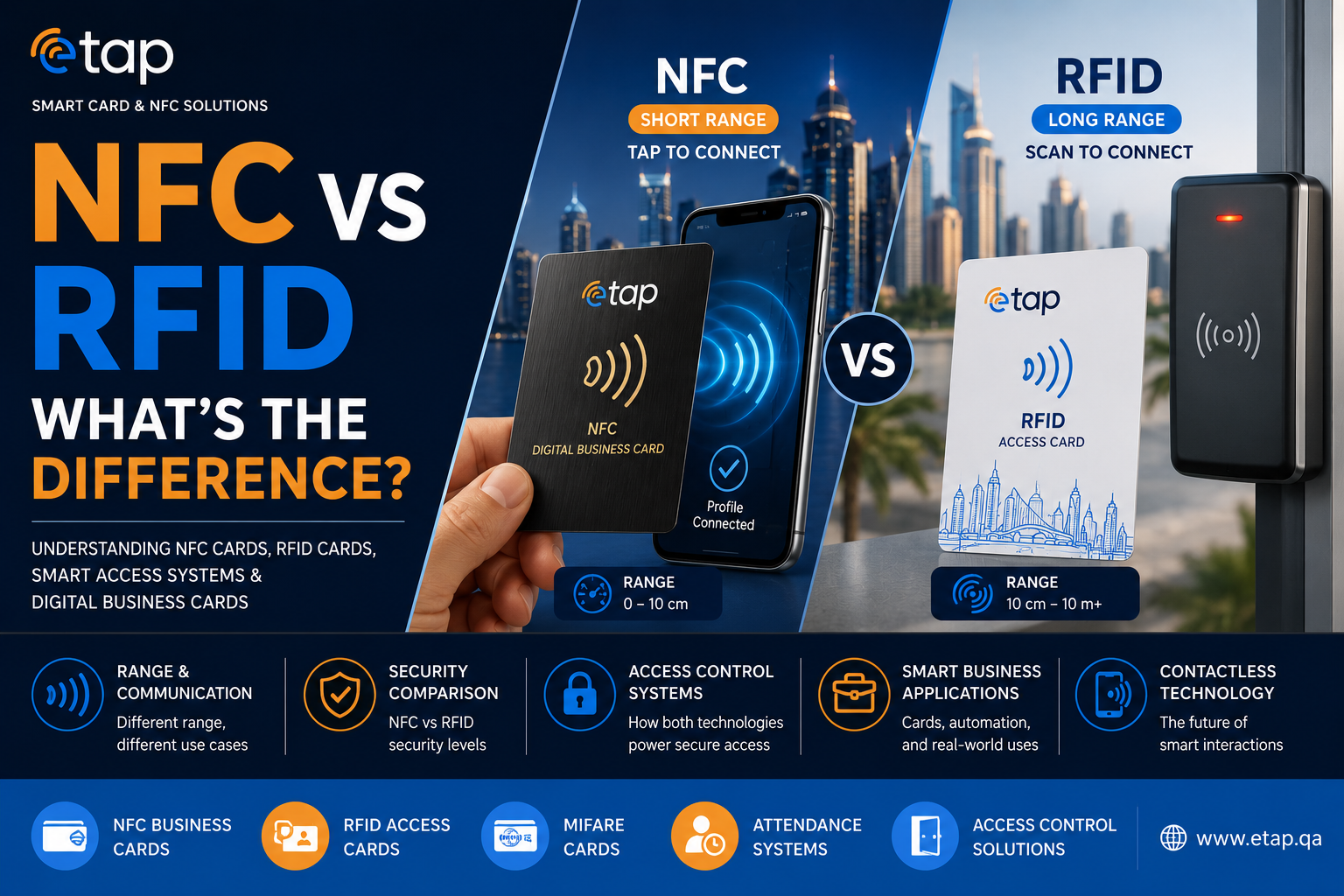
NFC stands for Near Field Communication. It is a specific subset of HF RFID that operates at 13.56 MHz, with a read range deliberately limited to approximately 4 centimeters (roughly the distance of a tap or touch).
NFC was developed in the early 2000s by Sony and Philips (now NXP Semiconductors), and standardized in a way that made it ideal for consumer devices. Almost every modern smartphone — iPhone, Samsung, Google Pixel — has an NFC chip built in. This made NFC the foundation for contactless payments, digital business cards, smart tags, and tap-based interactions that billions of people use every day.
NFC can operate in three modes:
Reader/Writer Mode — The NFC device (e.g., your phone) reads or writes to a passive NFC tag. This is what happens when you tap an etap NFC business card or NFC review stand.
Peer-to-Peer Mode — Two NFC-enabled devices exchange data directly with each other. Used for file transfers and pairing.
Card Emulation Mode — The NFC device behaves like a contactless smart card. This is what powers Apple Pay, Google Pay, and contactless bank cards.
In practical terms, NFC is the technology behind:
- Digital business cards (like etap NFC cards)
- Contactless payments (Apple Pay, Samsung Pay, card tap-to-pay)
- Google review stands and QR/NFC display stands
- Hotel room key cards (many modern hotels)
- Transit cards in smart cities
- Smart tags for marketing, product authentication, and access
Simple Analogy
Think of RFID as a broad family of wireless identification technologies — like the word “vehicle” covering cars, trucks, motorcycles, and buses. NFC is a specific member of that family: it is the small, deliberate, close-range, two-way version — like a compact city car designed specifically for urban environments.
All NFC is RFID. But not all RFID is NFC.
NFC vs RFID: Key Differences
| Feature | RFID | NFC |
|---|---|---|
| Frequency range | LF (125kHz), HF (13.56MHz), UHF (860–960MHz) | HF only (13.56MHz) |
| Read range | Up to 12+ meters (UHF) | Up to ~4 cm |
| Communication direction | One-way (reader to tag) | Two-way (device to device or device to tag) |
| Device compatibility | Requires dedicated reader hardware | Built into all modern smartphones |
| Speed | Variable (UHF is very fast) | Up to 424 kbit/s |
| Common uses | Inventory, asset tracking, logistics, and access control at scale | Payments, digital cards, marketing tags, smart displays |
| Security | Varies; UHF can be intercepted at range | Short range significantly reduces interception risk |
| Cost | LF/HF tags are cheap; UHF readers are moderate to expensive | NFC tags are inexpensive; the phone is the reader |
| Best for | Industrial, logistics, large-scale tracking | Consumer-facing, networking, payments, smart interactions |
HF RFID and NFC: Where They Overlap
Because NFC operates at 13.56 MHz — the same frequency as HF RFID — many HF RFID tags are actually readable by NFC-enabled smartphones if they follow the right data standard (NDEF format).
This is important for businesses in Qatar that want a contactless solution compatible with both:
- Dedicated RFID reader hardware (for back-office systems, access control, attendance)
- Customer smartphones (for tap-based interactions, review cards, menus)
An etap NFC card, for example, operates at 13.56 MHz and is programmed in NDEF format — making it readable by any NFC smartphone without additional hardware. This is the sweet spot where modern business NFC solutions live.
When to Choose RFID or NFC
Choose RFID When:
You need long-range detection. If your system needs to detect items, vehicles, or people from more than 1 meter away, UHF RFID is your answer. Warehouse conveyor belts, vehicle access gates, and large retail inventory systems all depend on UHF RFID’s range.
You’re tracking high volumes of assets. A UHF RFID reader can scan hundreds of tagged items simultaneously in seconds — something NFC physically cannot do at close range. Large hotels tracking linens, hospitals tracking equipment, and logistics companies tracking shipments all rely on this.
Your environment is controlled. RFID deployments typically involve fixed readers and a controlled flow of tagged items or personnel. If you’re building an access control system for an office building, a car park, or an industrial site, RFID is the infrastructure choice.
You don’t need smartphone compatibility. If your system is entirely back-end — connecting to a server, triggering gates, logging data — you don’t need NFC’s consumer-device compatibility. Standard RFID hardware is simpler and more cost-effective.
Choose NFC When:
You want to interact with smartphones. NFC’s greatest advantage is that the reader is already in the customer’s pocket. No hardware installation required. Tap an etap NFC business card, NFC review stand, or NFC menu stand, and the phone does the rest.
You’re building a customer-facing experience. Google review cards, digital business cards, restaurant menu stands, social media cards, and hotel welcome cards all benefit from NFC’s ease of use and universal smartphone compatibility.
Security through proximity is an advantage. For payments and sensitive data exchanges, NFC’s 4 cm range means a card can only be read when the user deliberately taps. This is far more secure than longer-range RFID for consumer transactions.
You want a modern, professional brand impression. An etap NFC card handed to a client during a meeting in Doha communicates exactly the kind of forward-thinking, tech-aware brand identity that businesses in Qatar are increasingly investing in.
RFID for Asset Tracking
One of the most powerful applications of RFID in Qatar’s business environment is asset tracking. Companies operating across multiple locations — from construction and oil & gas to hospitality and healthcare — manage enormous volumes of physical assets that need to be located, audited, and maintained on schedule.
UHF RFID enables:
- Real-time location of tools, equipment, and vehicles across a facility
- Automated inventory audits without manual scanning
- Maintenance scheduling triggered by RFID check-ins
- Prevention of theft or unauthorized removal of assets
The return on investment for RFID-based asset tracking is well-documented, particularly for businesses where lost or misplaced equipment carries a high cost.
NFC for Industrial and Fleet Use
While UHF RFID handles large-scale logistics, NFC fills a different role in industrial environments: the point of interaction where a worker, technician, or manager needs to log an action, verify an identity, or access a digital record using nothing but a smartphone.
Examples include:
- A maintenance technician tapping an NFC tag on a piece of equipment to access its service history
- A security guard tapping NFC checkpoints during rounds to log time-stamped patrol records
- Fleet managers are attaching NFC tags to vehicles so drivers can tap to log trips, access documents, or record departure/arrival
- Site managers are using NFC tags on machinery to enforce pre-start safety checklists
In these applications, NFC’s smartphone compatibility means zero specialized hardware at the point of interaction. The tag costs very little. The record goes directly into a database. It’s lightweight, scalable, and effective.
Frequently Asked Questions
Is RFID better than NFC?
Neither is universally better — they serve different purposes. RFID is better for long-range, high-volume, infrastructure-level identification (inventory tracking, vehicle access gates, large-scale asset management). NFC is better for short-range, consumer-facing, smartphone-compatible interactions (business cards, payments, review stands, smart tags). The right choice depends entirely on your use case.
Which should I choose: NFC or RFID?
Ask yourself: does your system need to work with customer or employee smartphones, or does it need to work with dedicated reader hardware at range? If smartphones choose NFC. If scale, range, and infrastructure, choose RFID (typically UHF). Many businesses in Qatar use both RFID for internal operations and NFC for customer-facing touchpoints. etap can help you design the right solution.
Is Apple Wallet NFC or RFID?
Apple Wallet uses NFC — specifically Card Emulation Mode, where the iPhone mimics a contactless smart card. When you pay at a terminal, your iPhone’s NFC chip communicates with the payment reader at 13.56 MHz within a few centimeters. Apple Wallet is not compatible with UHF RFID systems.
Do credit cards use NFC or RFID?
Modern contactless bank cards (Visa Paywave, Mastercard Contactless) use HF RFID operating at 13.56 MHz, which is the same frequency band as NFC and follows the ISO 14443 standard used by NFC. In practical terms, these cards are NFC-compatible, which is why you can sometimes read them with an NFC app on your phone. The underlying protocol is EMV contactless, which sits on top of HF RFID/NFC standards.
Does tap to pay use NFC or RFID?
Tap to pay — whether with a card, phone, or smartwatch — uses NFC (or HF RFID operating under the same ISO 14443 standard, depending on how precisely you want to define it). Payment terminals are NFC readers. Your card or phone is the tag/emulator. The transaction happens at 13.56 MHz within a few centimeters.
Do iPhones need RFID protection?
iPhones use NFC for Apple Pay, which only activates when the user deliberately initiates a payment (requires Face ID, Touch ID, or double-click). iPhones cannot be silently charged or have data stolen via NFC during normal carry. RFID-blocking wallets are primarily useful for protecting HF RFID bank cards (contactless credit/debit cards) — not iPhones. That said, if your wallet contains multiple contactless cards, an RFID-blocking sleeve prevents accidental reads.
Can Apple Wallet be hacked?
Apple Wallet’s NFC payments use tokenization — your real card number is never transmitted. Instead, a one-time device account number is used for each transaction. Even if someone intercepted the NFC signal (extremely difficult given the 4 cm range), the token would be useless for future transactions. Apple Wallet is considered one of the most secure payment methods available today.
Is RFID outdated?
No. RFID is not outdated — it is evolving. UHF RFID in particular is experiencing significant growth driven by retail inventory management, supply chain automation, and smart logistics. New RFID chip designs are smaller, cheaper, and more capable than ever. What has changed is the landscape of use cases: NFC has absorbed the consumer-facing, short-range applications, while RFID continues to dominate industrial, logistics, and infrastructure use cases.
Are key fobs RFID or NFC?
Most office and building access key fobs use LF RFID (125 kHz, EM4100 or HID format) or HF RFID (13.56 MHz, MIFARE format). Standard key fobs are generally not NFC-compatible in the sense that they can’t communicate with smartphones — they require a dedicated access control reader. Some modern access systems do use NFC-standard 13.56 MHz credentials, which can be loaded onto a smartphone or NFC card. If you’re building or upgrading an access control system in Qatar, etap can advise on NFC-compatible credentials that work with both physical cards and smartphones.
Are animal microchips RFID or NFC?
Animal microchips are LF RFID, typically operating at 125 kHz or 134.2 kHz (ISO 11784/11785 standard). They are passive tags the size of a grain of rice, implanted under the skin, and readable by dedicated veterinary or animal shelter scanners. They are not NFC and cannot be read by a standard smartphone. Their long track record, durability, and resistance to interference make LF RFID ideal for this application, even if the read range is very short.
Conclusion
NFC and RFID are two sides of the same wireless identification coin. RFID is the broad technology family — spanning low-frequency animal chips to ultra-high frequency warehouse systems — built for range, volume, and infrastructure. NFC is the refined, consumer-ready, smartphone-native member of that family, built for the human touchpoint: the tap, the payment, the introduction, the review.
For businesses in Qatar in 2026, the practical picture looks like this:
- If you need to connect with customers or share your identity as a professional, NFC is your tool — and etap’s NFC card range is where to start.
- If you need to track assets, manage access at scale, or automate inventory, RFID (typically UHF) is your infrastructure.
- If you need both, etap can help you design a combined solution that uses each technology where it performs best.
etap is Qatar’s leading provider of NFC cards, RFID cards, and smart contactless solutions for businesses, professionals, and enterprise clients. From NFC digital business cards and Google review stands to custom RFID solutions for offices and facilities, we design, produce, and program everything in-house in Doha.
Ready to explore the right solution for your business?
📱 WhatsApp: +974 55769142 📧 Email: [email protected] 📍 Al Naif Souq, Ain Khaled, Doha, Qatar 🌐 etap.qa