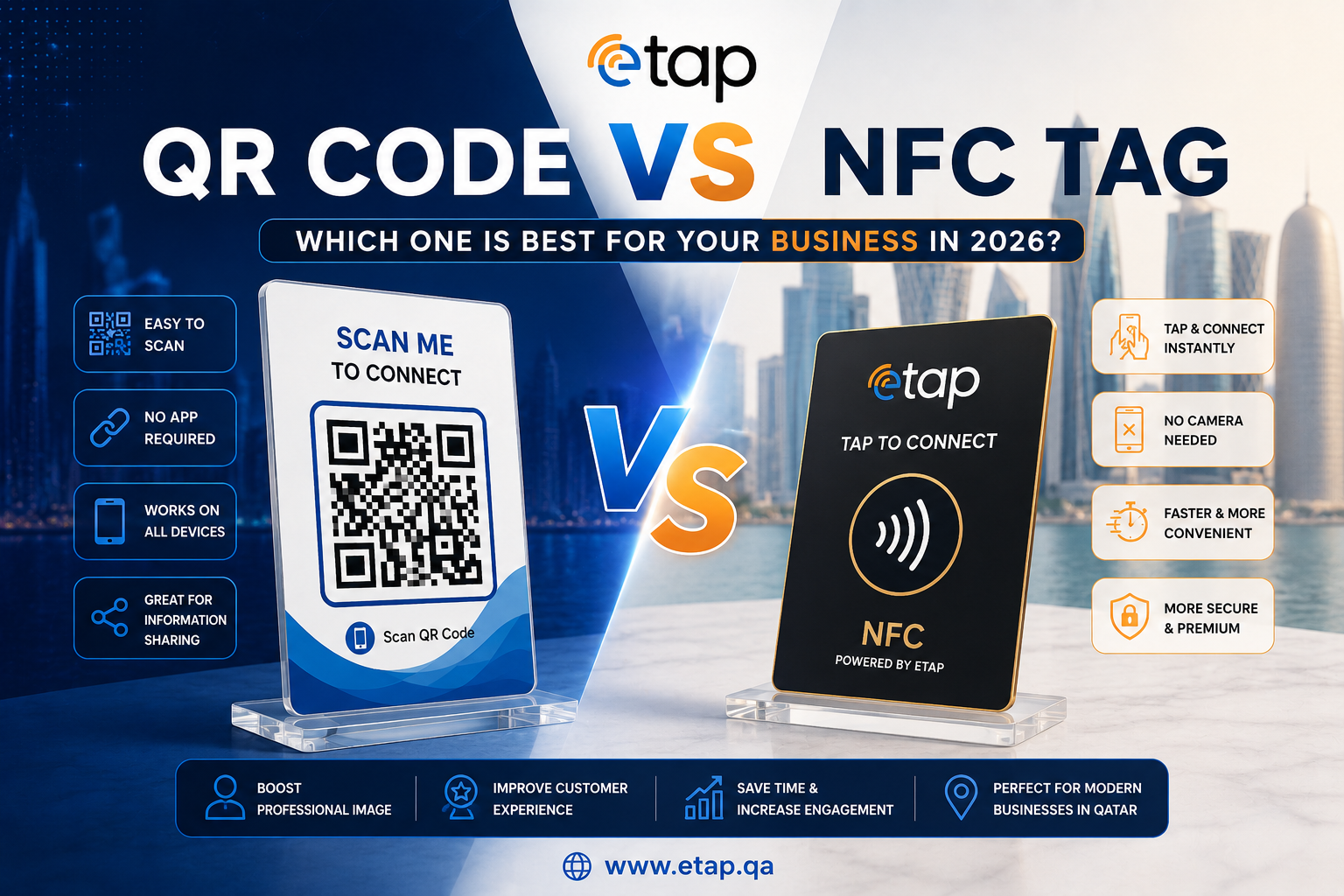
Two technologies are competing to become the universal standard for contactless communication — and both are already deeply embedded in how Qatar businesses operate every day.
QR codes are everywhere. You scan them to see a menu, pay a bill, or follow a brand on Instagram. NFC tags power contactless payments, smart business cards, and hotel key card systems. Both are fast. Both are contactless. Both are capable of transforming how your business connects with customers and partners.
But which one is actually better for your business?
The honest answer is that it depends on what you are trying to accomplish. This complete guide breaks down QR codes and NFC tags across every factor that matters — accessibility, security, cost, use cases, and brand protection — and gives you a clear, practical answer for choosing the right technology, or the right combination of both.
What Is a QR Code?
A QR code (Quick Response code) is a two-dimensional matrix barcode originally invented in Japan in 1994 for tracking automotive parts. Today, it is one of the most universally recognised symbols in the world — printed on restaurant menus, product packaging, business cards, billboards, receipts, and virtually every other surface that communicates with customers.
A QR code stores information as a pattern of black and white squares arranged in a grid. A smartphone camera reads this pattern by scanning it and immediately interprets the encoded data — typically a URL, text, contact information, or a payment instruction.
There are two types of QR codes:
Static QR codes are fixed at the point of creation. Once printed, the destination they point to cannot be changed without creating and printing a new code. They are simple, free to generate, and completely functional — but inflexible once deployed.
Dynamic QR codes are generated through a management platform and can be updated at any time after printing. The physical code stays the same on your card or stand, but the destination URL can be changed instantly from a dashboard. Dynamic codes also provide scan analytics — how many times the code was scanned, from which devices, and from which locations.
QR codes require no special hardware on the scanning device. Any smartphone with a camera — which includes virtually every smartphone ever made — can read a QR code. This universal compatibility made QR codes the dominant contactless technology during the COVID-19 pandemic, when businesses worldwide deployed them for menus, check-ins, and contact tracing almost overnight.
What Is NFC?
NFC stands for Near Field Communication. It is a short-range wireless communication technology that operates at 13.56 MHz and enables two devices — most commonly a smartphone and a smart tag or card — to exchange data when held within a few centimetres of each other.
Unlike QR codes, NFC does not require a camera or a scanning action. The user simply holds their phone near the NFC tag or card. The chip activates wirelessly through the phone’s NFC field and transmits its stored data in under two seconds — opening a URL, saving a contact, displaying a digital profile, or triggering any other programmed action.
NFC technology has been embedded in smartphones since the early 2010s and is now standard in virtually all modern devices — including all iPhones from the iPhone 7 onwards and essentially every Android smartphone made after 2015.
NFC tags come in several forms: embedded in smart cards (like etap’s NFC business cards and Google Review stands), in stickers and labels that can be applied to any surface, in wristbands, key fobs, acrylic stands, and a growing range of custom-printed products.
At their core, NFC tags contain a small microchip and a copper or aluminium antenna, all sealed within a thin, durable package. The chip stores data — typically a URL, but potentially contact information, access credentials, or more complex data structures depending on the chip type and application.
Why Are QR Codes and NFC Useful?
Both technologies solve the same fundamental problem: they bridge the physical and digital worlds in a single, fast, frictionless interaction. Without them, connecting a physical product, card, or space to a digital destination requires the user to manually type a URL, search for a business, or navigate a series of steps — all of which introduce friction and reduce the likelihood of the action being completed.
With a QR code or NFC tag, that bridge is crossed in one action. One scan or one tap, and the user is exactly where you want them to be — your menu, your review page, your social media, your payment link, your digital profile.
For businesses in Qatar, this matters enormously. Qatar has one of the highest smartphone penetration rates in the world, and its business community is internationally connected and digitally sophisticated. Customers in Doha expect seamless digital interactions. Whether you are a restaurant in The Pearl, a hotel in Lusail, a corporate professional in West Bay, or a retail brand in a Doha mall, the ability to connect your physical presence to your digital world instantly and elegantly is a competitive advantage.
Both QR codes and NFC tags deliver this capability. The question is which delivers it better — and in which context.
A Comparison Between NFC and QR Codes
Ease of Use
QR codes require the user to open their camera app, point it at the code, hold it steady while it focuses, wait for the scan to register, and then tap the link that appears on screen. On modern smartphones, this takes 3–8 seconds and is familiar to almost everyone.
NFC requires the user to hold their phone near the tag. No camera app, no scanning, no focusing, no waiting. Under 2 seconds from phone proximity to the result. For users who have not experienced NFC before, the first interaction typically produces a visible reaction of surprise and delight — it genuinely feels instantaneous.
Winner: NFC — meaningfully faster and more frictionless for the end user.
Device Compatibility
QR codes work on every smartphone with a camera — including every budget device, older phones, and devices from brands that may not support NFC. Universal compatibility with zero exceptions.
NFC is supported on all iPhones from iPhone 7 (2016) onwards and virtually all Android smartphones from 2015 onwards. The overwhelming majority of smartphones in active use in Qatar today support NFC. However, a small number of older or entry-level devices may not — and some users may have NFC disabled in their settings.
Every etap NFC product also includes a QR code as a backup, ensuring that your information is always accessible regardless of the recipient’s device or settings. This combination approach gives you the best of both technologies.
Winner: QR code — universal compatibility with every device. NFC closes the gap with QR code backup.
Security and Brand Protection
This is where the comparison becomes particularly significant for businesses that use contactless technology for brand communications, product authentication, or secure access.
QR codes are vulnerable. A QR code is simply a printed pattern. Anyone with a printer can create a QR code that looks identical to yours — or nearly so. There are documented cases worldwide of fraudulent QR code stickers being placed over legitimate ones in public spaces to redirect unsuspecting users to phishing pages, fake payment portals, or malicious websites.
For brand protection, this is a critical weakness. A counterfeit product with a fake QR code that points to a counterfeit website can undermine your entire authentication system. Customers scanning a QR code have no way to verify that the code has not been tampered with.
NFC tags offer significantly stronger security. NFC chips can be read-only after programming — meaning their content cannot be modified once set. Advanced NFC chip variants like Mifare DESFire use AES (Advanced Encryption Standard) encryption, the same standard used by financial institutions. This makes them extremely difficult to clone or tamper with.
For brand protection specifically, NFC smart labels represent a step-change in security capability. An NFC-secured product label can contain encrypted authentication data that a counterfeiter cannot replicate — every tap verifies the product’s authenticity against a secure database. QR codes simply cannot offer this level of protection.
Winner: NFC — significantly more secure for brand protection, authentication, and sensitive applications.
Cost
QR codes are free to generate. Dozens of online tools create QR codes in seconds at no cost. For static QR codes, the only cost is printing. For dynamic QR codes with analytics and update capability, a subscription to a QR management platform is typically required — usually a few hundred QAR per year for a small business.
NFC tags require an embedded chip, which adds a per-unit cost to the product. etap’s NFC products start from QAR 50 for stickers and tags and QAR 150 for premium business cards — a one-time cost that never needs to be repeated as long as the tag remains functional.
For large-scale deployments — packaging inserts, product labels at volume — QR codes have a clear cost advantage. For individual professional tools, premium branded products, and high-value interactions, NFC’s one-time cost is easily justified by the superior user experience and durability.
Winner: QR code for large-scale, low-cost deployment. NFC for premium, long-term individual use.
Durability
QR codes printed on paper or standard card stock are vulnerable to physical wear — scratches, fading, water damage, and folding can all render a code unreadable. On laminated or UV-printed surfaces (like etap’s products), QR codes are significantly more durable — but even then, surface degradation can eventually affect readability.
NFC chips are sealed within the card or tag body. The chip itself has no moving parts and does not degrade with use. A well-manufactured NFC card or tag can function reliably for years of daily use. The chip is also protected from moisture, dirt, and physical wear by its encapsulation within the host product.
Winner: NFC — more reliably durable for long-term deployment.
Analytics and Tracking
QR codes offer scan analytics through dynamic QR code platforms — total scans, device types, locations, and time data. This is a genuine advantage of QR codes over NFC when using premium dynamic platforms.
NFC tags typically provide tap analytics through the connected digital profile platform. etap’s NFC products include real-time analytics showing every tap, device type, and location. The analytics capability is comparable to dynamic QR codes when using a platform like etap’s BioLink.
Winner: Tie — both offer strong analytics on premium platforms.
QR Code vs NFC for Brand Protection
Brand protection is a growing concern for businesses in Qatar and across the Gulf as counterfeit goods become increasingly sophisticated. Let us look at how each technology addresses this challenge.
QR Codes: Accessible but Vulnerable
QR codes are excellent for directing customers to digital content quickly and cheaply. But for brand protection, their core weakness — the fact that any QR code can be replicated or overlaid — is a significant limitation.
A counterfeit product carrying a fake QR code that opens a convincing fake website provides no real authentication. Customers scanning that code have no way to know they are not looking at a genuine product. The QR code, in this context, gives a false sense of security rather than genuine protection.
Even with security design elements — unique serial numbers, holographic surrounds, or tamper-evident printing — QR codes remain fundamentally vulnerable to a sufficiently motivated counterfeiter.
NFC Smart Labels: Secure, Dynamic, and Versatile
NFC smart labels solve the core security weakness of QR codes. Because the chip can be locked after programming, the data it contains cannot be overwritten by a counterfeiter. Advanced encryption in Mifare and other premium NFC chip families means that even reading the chip’s raw data provides no advantage to a bad actor — the data can only be validated against a secure server.
An NFC-secured product label enables genuine, cryptographically verifiable product authentication. When a customer taps the label, the backend system checks not just that the chip is present, but that the specific chip with that specific identifier is a known, registered, authentic unit — and that it has not been previously tapped an unexpected number of times (which could indicate a stolen or cloned tag being reused on a counterfeit).
Dual Chip (NFC + RFID): The Future of Secure Logistics
For supply chain and logistics applications — increasingly relevant for Qatar’s growing retail and distribution sector — dual-chip solutions combining NFC for consumer-facing authentication and RFID for backend logistics tracking represent a powerful convergence.
The consumer taps the product with their phone (NFC) to verify authenticity and access brand content. Meanwhile, the same product carries an RFID chip that warehouse scanners read automatically at every stage of the supply chain — enabling end-to-end traceability without any human action.
etap supplies Mifare RFID cards and smart tags that form the building blocks of these secure logistics solutions for businesses across Qatar.
Why NFC Smart Labels Are the Smarter Choice for Brand Protection
For businesses that need genuine brand protection — luxury goods, pharmaceuticals, electronics, premium food and beverage, official merchandise — NFC smart labels are the smarter choice. The security advantages over QR codes are not marginal; they are fundamental. A counterfeit QR code is easy to produce. A counterfeit NFC chip with matching encryption is effectively impossible for most bad actors.
Advantages and Disadvantages: The Complete Picture
Advantages of QR Codes
Universal compatibility — works on every camera-equipped smartphone without exception. Free to generate and essentially free to add to any printed material. Visible and immediately recognisable — customers know what to do when they see a QR code. No battery or power source required. Works at a distance — users do not need to be in physical contact with the code. Dynamic QR codes can be updated after printing without reprinting.
Disadvantages of QR Codes
Requires camera app to be open and intentional scanning action — more friction than NFC. Vulnerable to physical damage, fading, and scratches. Can be easily cloned, overlaid, or replaced by fraudulent codes. No haptic feedback — the user has no physical confirmation that the scan worked. Less impressive first impression for professional networking contexts. Static QR codes offer no analytics. Dynamic QR codes require ongoing subscription costs for management platforms.
Advantages of NFC
Fastest contactless interaction — under 2 seconds, no camera, no scanning required. Highly secure — chips can be locked and encrypted to prevent cloning or tampering. Superior durability — chip is sealed within the product and not affected by surface wear. Haptic or visual feedback confirms the interaction worked. More memorable and impressive in professional contexts — creates a distinctive moment. Can carry more complex data, including encrypted credentials. Works in environments where visual alignment is difficult (packaging, inside boxes). Real-time analytics are included with premium platforms like etap’s BioLink.
Disadvantages of NFC
Requires NFC-enabled device — most modern phones are compatible, but a small number are not. Higher per-unit cost than printed QR codes. Requires proximity — works only within a few centimetres, not at a distance. Less familiar to some users who have not experienced NFC tapping before (though familiarity is growing rapidly).
Which One Should You Choose?
Here is a practical decision guide based on your specific use case:
Choose QR code if: You need maximum compatibility with every possible device. You are deploying at a large scale where per-unit cost is a primary constraint. You need to print on existing materials without adding chip cost. Your application is primarily about directing people to digital content quickly and cheaply — menus, event signage, outdoor advertising, and packaging inserts.
Choose NFC if: You want the best possible user experience and first impression. You are deploying professional business cards, networking tools, or premium branded products. Security and anti-counterfeiting are important for your product or brand. You need access control, attendance management, hotel key card functionality, or other applications requiring encrypted authentication. Durability is important — the product will be handled daily for months or years.
Use both together if: You want maximum reach combined with a premium experience. This is exactly what etap recommends and builds into every product — an NFC chip for the primary tap interaction, a QR code printed on the same card or stand as a universal fallback. Every customer is covered. No one is excluded.
Final Thoughts: Choosing the Right Tool for Your Brand
QR codes and NFC are not really competitors — they are complementary technologies that each excel in different contexts. The smartest businesses in Qatar in 2026 are not choosing one over the other. They are using both — NFC for the primary interaction, where it delivers a superior experience, and QR code as a universal backup that ensures no customer is ever unable to engage.
etap builds this dual-technology approach into every product we make. Our NFC digital business cards, Google Review stands, food menu stands, and social media cards all include both an embedded NFC chip and a printed QR code — giving every recipient the fastest, most impressive experience their device supports.
Whether you are an individual professional upgrading from paper cards, a restaurant deploying review collection stands, or a corporation implementing a secure access system, etap has the right combination of NFC and QR code technology for your specific needs.
Visit etap.qa/shop to browse the full range, or contact our team on WhatsApp at +974 55769142 for a free consultation.
Frequently Asked Questions
Does etap’s NFC card also have a QR code?
Yes. Every etap NFC card and stand includes both an NFC chip and a printed QR code. This ensures that every customer — regardless of their device — can access your digital profile or destination.
Can I update what my NFC tag or QR code points to after it is printed?
Yes for both technologies when using etap’s platform. Your BioLink digital profile — connected to both your NFC chip and QR code — can be updated at any time from any device. No reprinting required.
Which is more popular in Qatar — NFC or QR code?
Both are widely used in Qatar. QR codes are more visible on printed materials across the country. NFC is more prevalent in professional networking cards, hotel systems, and corporate access control. The trend is strongly toward NFC for premium applications as smartphone NFC compatibility becomes universal.
Is NFC safe to use?
Yes. NFC operates at very low power over very short distances. There are no known health risks associated with NFC technology. Chip data is encrypted and cannot be read by third parties at a distance — unlike QR codes, which can be photographed from across a room.